Rain is the great saboteur of recreational tennis. You’ve booked the court, found a partner, driven across the city, and now it’s spitting. Do you play through it? Pack up immediately? Stand under the overhang arguing about it for 20 minutes? After 25 years of Canadian club tennis, I’ve done all three. Here’s the honest answer.
What Actually Happens When You Play in the Rain
Playing tennis in light rain is possible on some surfaces — but it changes the game significantly and carries real risks your partner probably isn’t mentioning.
| Condition | Hard Court | Clay Court | Grass Court |
|---|---|---|---|
| Light drizzle | Playable with caution | Playable, slower bounce | Dangerous immediately |
| Moderate rain | Slippery, not recommended | Very slippery, stop | Stop immediately |
| Heavy rain | Stop | Stop | Stop |
Hard courts become dangerously slippery within minutes of rain. The painted acrylic surface holds a thin film of water that acts like ice when you push off laterally. This is how recreational players tear ACLs in October.
Clay courts actually play through light rain better than hard courts — the clay absorbs moisture and the surface becomes slower and heavier rather than immediately slippery. But once the court is saturated, footing becomes treacherous and the balls pick up clay that clogs the felt and unbalances the bounce.
Grass courts are always a no. Wet grass is genuinely dangerous. No recreational player should be sprinting on wet grass. If you’re at a club with grass courts and it rains, you leave.
What Rain Does to Your Equipment
Your balls: Rain ruins pressurised tennis balls. Water soaks the felt, adds weight, changes the bounce completely, and accelerates pressure loss. Playing a can of balls in the rain effectively destroys them. If it rains more than lightly, those balls are finished for serious play.
Your racket: Modern graphite rackets handle light moisture fine. The real damage is to your strings — wet polyester strings lose tension faster, and wet natural gut is genuinely expensive to ruin. Your grip tape becomes useless wet. And if you’re using an overgrip, a wet overgrip provides almost no grip security, which changes your swing mechanics and risks racket slippage.
Your shoes: Wet hard courts destroy outsoles faster than dry ones. The abrasion pattern changes and you lose traction unpredictably.
🎾 Wet Weather Gear That Actually Helps
A quality overgrip becomes even more critical in wet conditions — tacky overgrips like the Tourna Grip or Wilson Pro Overgrip provide significantly better wet-weather grip than standard grips.
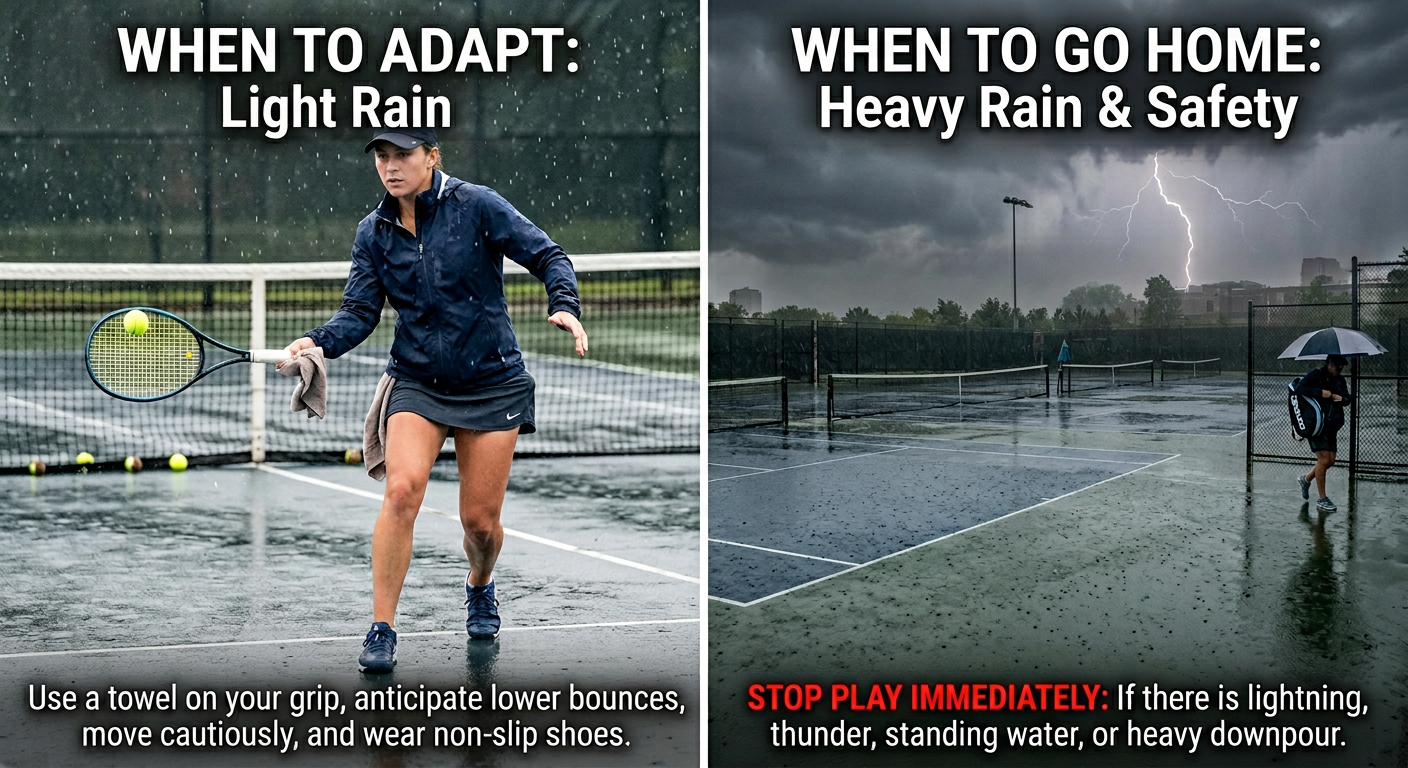
The Real Decision: When to Play Through It
Play through it if:
- It’s a genuine light drizzle (not building)
- You’re on a hard court with no standing water
- The temperature is above 10°C (wet and cold is miserable)
- Both players agree — don’t pressure your partner
- You’re wearing tennis shoes with lateral support and current tread
Stop immediately if:
- There’s visible standing water anywhere on the court
- You feel the surface getting slippery underfoot
- It’s raining hard enough that the balls are noticeably heavier
- There’s lightning anywhere in the area — this is non-negotiable, stop playing immediately and get inside
- Either player is uncomfortable — recreational tennis isn’t worth an injury
Lightning: The Non-Negotiable Rule
If there is lightning anywhere within visual range, you stop and you go inside. You do not finish the set. You do not wait under a tree. You go inside. Tennis courts — flat, open, with metal fencing — are genuinely dangerous during lightning storms. The ITF, Tennis Canada, and every club in the country have the same policy. Don’t be the person who ignores this one.
Canadian-Specific Reality
In Vancouver and coastal BC, playing through light rain is part of club culture — players who insist on dry conditions never get on court October through April. The clay court players especially develop a tolerance for damp conditions. In Ontario and Quebec, summer thunderstorms are the bigger risk — those build fast and produce lightning. Alberta gets both. Wherever you are, the lightning rule doesn’t change.
🎾 Make the Most of Rain Days
Rain days are excellent for gear maintenance. Clean your racket grips, apply a fresh overgrip, check your strings, and actually read the tennis racket grip size guide to confirm you’re playing the right size. The best players use cancelled sessions productively.
How to Protect Your Gear If You Do Play in Rain
- Bring extra overgrips — plan to replace it after any wet session
- Keep your balls in the tube between games — extends their life even in light rain
- Dry your racket face and strings between points with a dry towel
- Change your shoes after — never leave wet tennis shoes sealed in your bag
- Air dry your bag — mould in a closed tennis bag is a real problem in Vancouver
Related Reading
- Best Tennis Overgrips in 2026
- Tennis Warm Up Routine
- Best Tennis Bags for Club Players
- How to Find a Tennis Partner in Canada
Frequently Asked Questions
Can you play tennis in the rain?
On hard courts, light rain is manageable with caution — the surface gets slippery but doesn’t immediately become unplayable. Clay courts handle light rain better than hard courts, though footing eventually becomes unsafe. Grass courts should be abandoned immediately in any rain. Heavy rain, standing water, or lightning means stopping regardless of surface.
Does rain ruin tennis balls?
Yes. Rain soaks the felt, adds weight, alters the bounce, and accelerates pressure loss. Balls played in moderate rain are effectively ruined for normal play. In light drizzle, storing balls in their tube between games extends their life somewhat, but expect noticeably reduced performance.
Is it safe to play tennis with lightning nearby?
No. Stop immediately and go inside. Tennis courts — open, flat, with metal fencing — are high-risk in lightning. The recommended safe distance from lightning is 6 miles (10 km). If you can see or hear lightning, you’re already at risk. Wait 30 minutes after the last lightning before returning to the court.
What’s the best grip for wet conditions?
Tourna Grip (the blue tacky grip) is the most popular choice for players who deal with moisture — either from rain or sweaty hands. It provides noticeably better traction than standard white overgrips in wet conditions. Replace it after any session that gets genuinely wet.
The Bottom Line
Light rain on a hard court is a personal call. Standing water, heavy rain, or lightning is not — you leave. After 25 years of club tennis in Canada, I’ve learned that the match you skip because of weather is far better than the ACL you tear because you didn’t. 🎾