Tennis racket grip size is the most important specification most recreational players never check. You buy a racket because it’s on sale, because it looks good, or because a friend recommended it — but you have no idea if the grip size is right for your hand. The wrong grip size silently sabotages your tennis: it causes wrist fatigue, increases tennis elbow risk, reduces spin generation, and makes the racket twist in your hand on off-centre hits.
After 25 years on the court, here’s the complete guide to tennis racket grip sizes in 2026 — including how to measure your hand, what each size means, and how to fix the wrong grip size without buying a new racket.
Tennis Grip Size Chart
| Grip Size | Inches | Millimetres | Best For |
|---|---|---|---|
| L0 | 4 inches | 102mm | Juniors, very small adult hands |
| L1 | 4 1/8″ | 105mm | Smaller adult women, larger juniors |
| L2 | 4 1/4″ | 108mm | Most adult women, smaller-handed men |
| L3 | 4 3/8″ | 111mm | Most adult men, larger-handed women |
| L4 | 4 1/2″ | 114mm | Larger adult men |
| L5 | 4 5/8″ | 118mm | Very large hands (uncommon) |
Note: Different brands print grip size differently. HEAD uses L1-L5 numbering. Wilson and Babolat often print grip size as 1-5 or as fractional inches (4 1/4″, 4 3/8″ etc). Same sizes, different labels.
Two Methods to Measure Your Grip Size
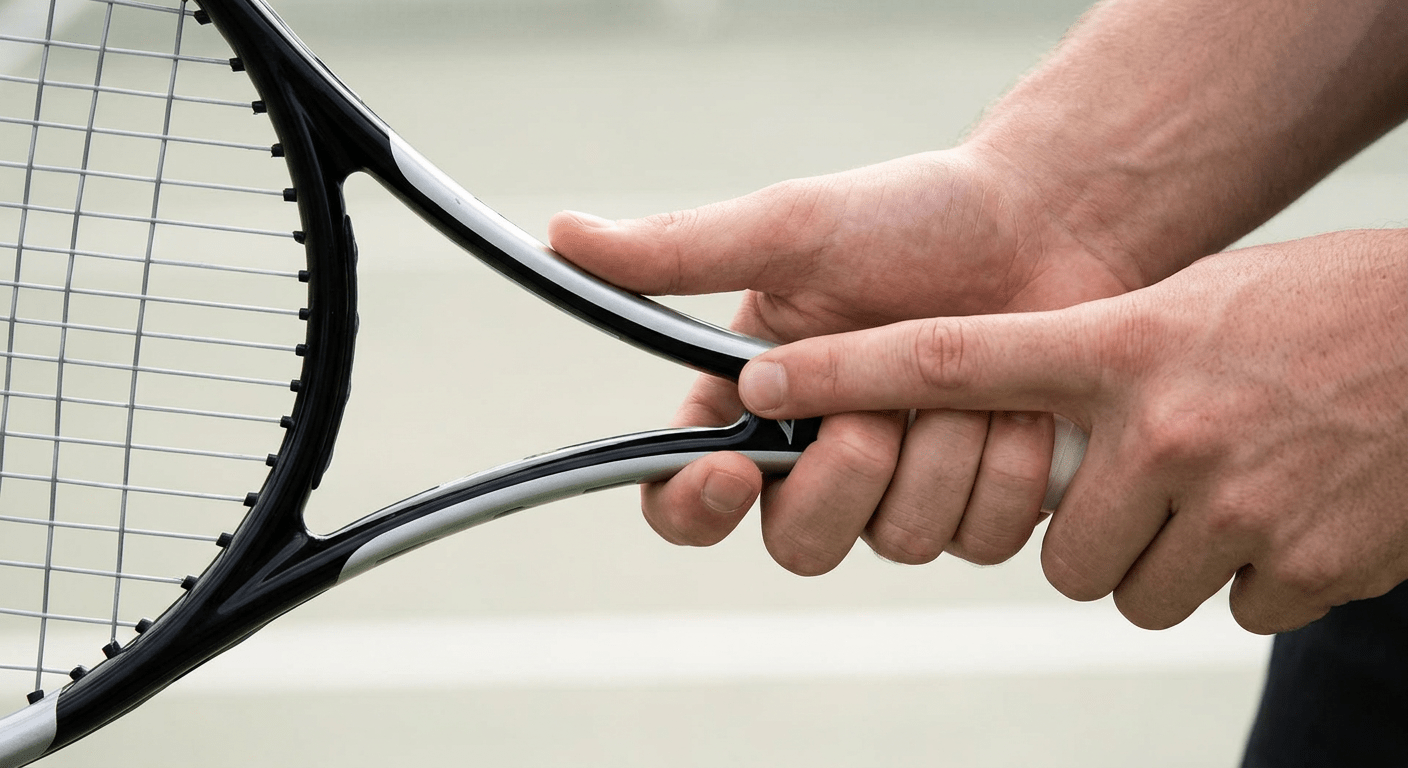
Method 1: The Finger Test (Quick and Practical)
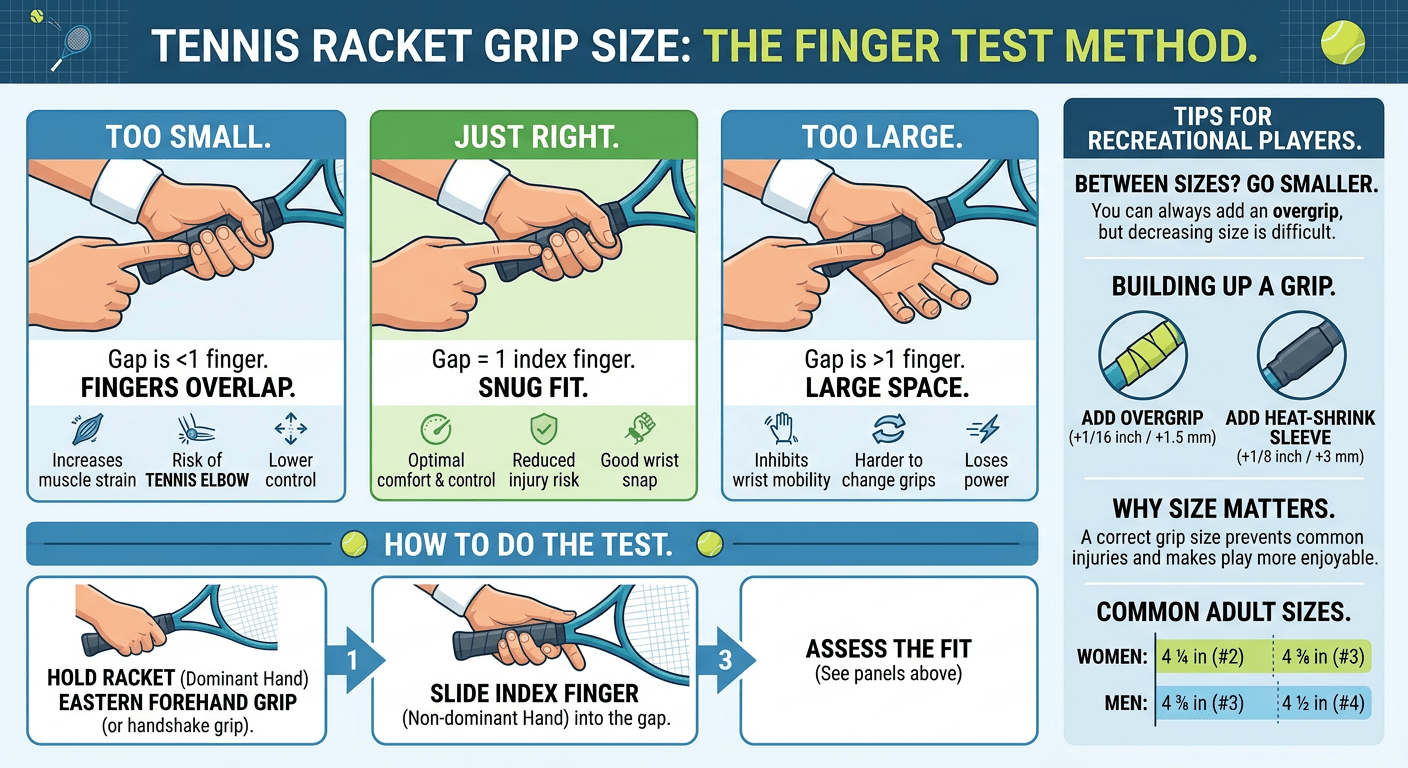
The fastest way to check grip size if you have a racket in hand:
- Hold the racket in your dominant hand using a continental (chopper) grip
- Place the index finger of your other hand into the gap between your fingertips and the base of your thumb (your palm)
- If your index finger fits comfortably with no extra space — grip size is correct
- If there’s more than one finger of space — grip is too small
- If your finger doesn’t fit at all — grip is too large
This is the standard method used by tennis pro shops worldwide. It’s not scientifically perfect but it’s reliable enough for almost all recreational players.
Method 2: The Ruler Measurement (More Precise)
For more precise measurement when you can’t physically test rackets:
- Open your dominant hand flat with fingers together and palm facing up
- Use a ruler to measure the distance from the bottom horizontal crease of your palm (the one closest to your wrist) to the tip of your ring finger
- The measurement in inches corresponds directly to your grip size
Example: a measurement of 4 3/8 inches means you should use grip size L3 (4 3/8″).
Signs Your Grip Size Is Wrong
Grip Too Small
- Wrist gets sore quickly during play
- You feel like you have to grip the racket extra tight to maintain control
- Racket twists in your hand on off-centre hits frequently
- You develop blisters at the base of your fingers
- Tennis elbow symptoms appear or worsen
Grip Too Large
- Difficulty generating wrist snap on serves
- Limited spin generation on groundstrokes
- Hand fatigue (different from wrist fatigue) during long rallies
- Difficulty switching grips between forehand, backhand, and serve
- Forearm gets tight after extended play
Common Grip Sizes for Different Players
- Junior players (under 12): L0 or L1 — depending on hand size and racket length
- Junior players (12-16): L1 or L2 — most common range for teenagers
- Adult women (smaller hands): L1 or L2
- Adult women (average hands): L2 or L3
- Adult men (smaller hands): L2 or L3
- Adult men (average hands): L3 — by far the most common adult male grip size
- Adult men (larger hands): L3 or L4
- Adult men (very large hands): L4 or L5
Important note: hand size doesn’t always correlate to body size. A 6’2″ man can have small hands. A 5’4″ woman can have larger hands. Always measure rather than assume based on overall build.
When in Doubt, Go Smaller
If you’re between sizes, choose the smaller grip. Two reasons:
- You can always make a grip larger by adding overgrips (each overgrip adds approximately 1/16″ to the grip size). You cannot make a grip smaller without major modifications.
- Smaller grips allow more wrist movement, which is critical for spin generation, kick serves, and modern stroke production.
Most professional players use grips smaller than would be predicted by their hand size for exactly this reason. Carlos Alcaraz uses L2 (4 1/4″) despite being a 6-foot adult male — most amateur players his size would default to L4.
How to Increase Grip Size (Without Buying a New Racket)
If your current racket is one grip size too small, fixing it is easy:
- Add an overgrip: Each overgrip adds roughly 1/16″ to the grip size. Two overgrips = 1/8″ increase = exactly one full grip size up.
- Use a heat-shrink sleeve: Available at pro shops, these slide over the existing grip and add 1/8″ to the grip size. More permanent than overgrips, requires minor heat application.
- Replace the underlying grip: Some replacement grips are thicker than standard, adding effective size without overgrip changes.
View Heat Shrink Sleeves on Amazon.ca
How to Decrease Grip Size
Reducing grip size is more difficult and almost always requires professional pro shop work. The methods involve:
- Removing the original grip and replacing with a thinner one
- Sanding down the underlying handle slightly (rare and risky)
- Selling the racket and buying the right size — usually the most practical solution
This is why “when in doubt, go smaller” is the cardinal rule. You can always add. You usually can’t subtract.
Special Considerations
If You Have Tennis Elbow
The wrong grip size is one of the most common contributors to tennis elbow. A grip that’s too small forces you to grip tighter, which transmits more shock through the arm. A grip that’s too large limits wrist movement, also adding strain. Get your grip size measured by a pro shop if you’re experiencing elbow issues. See our tennis elbow guide for the complete relationship between equipment and arm injuries.
For Two-Handed Backhand Players
Two-handed backhand players sometimes prefer slightly smaller grips because both hands are on the racket and the additional control comes from the second hand rather than grip size. Most two-handers use the same grip size as one-handers, but going one size smaller is a reasonable experiment.
For Heavy Topspin Players
Aggressive topspin generation requires significant wrist movement. Smaller grips allow more wrist freedom and produce more topspin per swing. If you play with heavy topspin, lean toward the smaller end of your appropriate range.
Buying Tennis Rackets in the Right Grip Size in Canada
Most online retailers (including Amazon.ca) list grip size as a selectable option when buying rackets. Always check before purchasing — buying online means you can’t physically test the grip first. If you’re uncertain, default to L3 for adult men and L2 for adult women, then adjust with overgrips if needed.
View Tennis Rackets on Amazon.ca
🎾 Stop Arguing About Grip Size
Done debating grip sizes with your hitting partner who insists you “should go a size up”? The “I’m not arguing — Just returning your serve” T-shirt from LooseTennisBalls is for players who know their gear and don’t need to defend it.
Related Reading
- Best Tennis Rackets for Recreational Players (2026)
- How to Choose the Right Tennis Racket Weight
- Best Tennis Overgrips 2026
- Tennis Elbow Prevention and Treatment
Frequently Asked Questions
What grip size do most tennis players use?
For adult men in 2026, L3 (4 3/8″) is by far the most common grip size. For adult women, L2 (4 1/4″) is the most common. These two sizes account for roughly 70% of all adult recreational tennis racket sales. If you’re uncertain and need to buy without measuring, defaulting to these sizes is reasonable.
How do I know if my tennis grip is too small?
Signs your grip is too small: wrist soreness during or after play, racket twists frequently on off-centre contact, you grip the racket harder than feels natural, blisters develop at the base of your fingers, or tennis elbow symptoms appear. Add an overgrip or heat shrink sleeve to increase the grip size as a quick fix.
Can I add an overgrip to make my grip larger?
Yes — each overgrip adds approximately 1/16 inch to the grip size. Two overgrips equals one full grip size up. This is the easiest and cheapest way to fix a slightly small grip. Multiple overgrips do reduce racket feel slightly, but it’s a reasonable trade-off for proper grip size.
What grip size does Roger Federer use?
Federer used L3 (4 3/8″) throughout his professional career — the standard size for adult male players. Most professional players use grips at the smaller end of what their hand size would predict, prioritising wrist freedom for modern stroke production over absolute control.
Is it bad to use the wrong grip size?
Yes — wrong grip size is one of the most common contributors to tennis elbow, wrist injuries, and grip-related blisters in recreational players. It also reduces spin generation, makes the racket harder to control, and limits the development of modern stroke techniques. Fixing grip size is one of the highest-impact equipment changes available.
Should I size up or down if I’m between grip sizes?
Always size down. You can easily add 1/16 to 1/8 inch with overgrips to make a smaller grip larger. Reducing a grip that’s too large requires removing and replacing the underlying grip — significantly more difficult and expensive. The “when in doubt, go smaller” rule is cardinal in tennis grip selection.
The Bottom Line
Test your grip size today using the finger method. If you’ve never checked, there’s a good chance your current racket isn’t quite right for your hand. The fix is usually as simple as adding an overgrip — a $3 solution to a problem that’s been silently sabotaging your tennis. 🎾