

The warm-up is the part of tennis that recreational players skip most often. You show up five minutes late, hit a few balls, and wonder why your first game feels like you’re playing in wet cement. Here’s how to actually prepare your body — in 15 minutes or less, based on 25 years of figuring out what actually works versus what looks impressive.
⚠️ Why Skipping Warm-Up Hurts You
Sports medicine research published in the British Journal of Sports Medicine consistently demonstrates that proper warm-up routines significantly reduce acute muscle injury rates. For recreational players, most tennis injuries happen in the first 20 minutes of play on cold muscles — exactly the period most players skip preparing for.
The Complete 15-Minute Pre-Match Routine
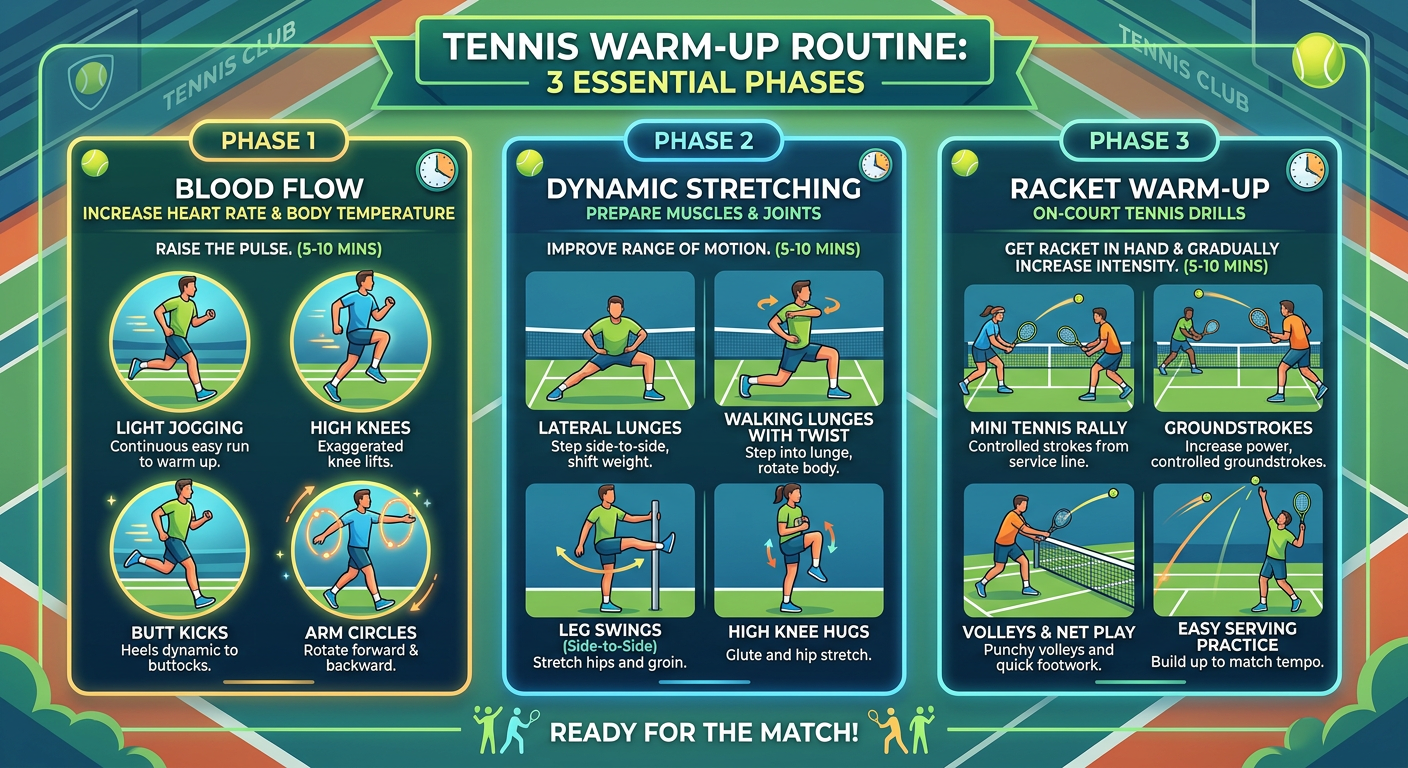
Phase 1: Get the Blood Moving (3 minutes)
Before any stretching, your muscles need blood flow. Skip the static stretching on cold muscles — it doesn’t help and may increase injury risk according to current sports medicine consensus.
- Light jog around the court × 2 laps
- High knees × 20 each leg
- Butt kicks × 20 each leg
- Side shuffles × 10 metres each direction × 2
Phase 2: Dynamic Stretching (5 minutes)
Dynamic = moving stretches. Not static holds. These prepare your muscles for the specific demands of tennis.
- Arm circles: 20 forward, 20 backward. Gradually increase range.
- Shoulder cross-body stretch: 15 seconds each arm, moving gently through it
- Hip circles: 10 each direction, hands on hips
- Leg swings: Forward/backward and side to side, 15 each leg
- Wrist rotations: 20 circles each direction — critical for the racket arm
- Torso rotations: 20 slow rotations, arms extended
Phase 3: Racket Warm-Up (7 minutes)
Now you pick up the racket. In this order:
Start at the service line, not the baseline. Mini-tennis first — short, controlled rallies with your partner to get hand-eye coordination online. After 2 minutes, move to the baseline. Hit 10 forehands cross-court, 10 backhands cross-court, then alternate. No full power yet — 60–70% pace only. Finish with 5–6 serves, starting with half-pace slice serves before moving to your full motion. Your body is now ready. Your first game will feel completely different.
The Body Parts Recreational Players Forget to Warm Up
| Body Part | Why It Matters | Quick Warm-Up |
|---|---|---|
| Wrist | Most stressed joint in racket sports | 20 rotations each direction |
| Forearm | Primary site of tennis elbow | Extend arm, gently flex wrist up/down × 15 |
| Shoulder rotator cuff | Most common severe tennis injury | Internal/external rotation with light resistance |
| Hip flexors | Limits your split step | Walking lunges × 10 each side |
| Ankles | Lateral movement on hard courts | Circle rotations, calf raises × 20 |
Resistance Bands — The Secret Weapon
For shoulder rotator cuff warm-up specifically, light resistance bands are the gold standard. 30 seconds of internal and external rotation with a light band before serving dramatically reduces shoulder injury risk. They cost $15–$25 CAD and fit in any tennis bag.
🎾 Resistance Band Set
A set of 3–5 graduated resistance bands covers all warm-up scenarios from light shoulder activation to deeper post-match stretching. Look for sets with a door anchor for shoulder external rotation work.
View on AmazonPost-Match Cool Down (Don’t Skip This Either)
Five minutes of walking, then static stretches. Hold each for 30 seconds. Focus on quads, hamstrings, calves, shoulder, and forearm. Players who cool down consistently report less next-day soreness — and it dramatically reduces your risk of developing tennis elbow over time.
- Quad stretch: Standing, pull foot to glute, hold 30 seconds each leg
- Hamstring stretch: Seated forward fold or standing toe touch, 30 seconds
- Calf stretch: Wall lean, back leg straight, 30 seconds each side
- Shoulder stretch: Cross-body arm pull, 30 seconds each arm
- Forearm stretch: Arm extended, gently pull fingers down then up, 30 seconds each direction
Foam Rolling for Tennis Players
Foam rolling 2–3 times per week dramatically improves muscle recovery and flexibility. For tennis players, focus on quads, IT band, calves, and upper back. 5 minutes per session is enough.
🎾 Standard Foam Roller
Medium-density foam rollers ($25–$45 CAD) are the right choice for most tennis players. Avoid the textured “trigger point” rollers initially — too aggressive for many users. Standard smooth foam rollers are easier to start with.
View on Amazon🎾 For the Player Who Skips Warm-Up
Stop talking about warming up. Start doing it. The “Just shut up and serve” T-shirt from LooseTennisBalls is for players who finally got the message. (After warming up properly first, of course.)
View on RedbubbleRelated Reading
- → Tennis Elbow Prevention and Treatment
- → How to Improve Your Tennis Serve in 30 Days
- → Best Hard Court Tennis Shoes (2026)
- → How to Fix Your Tennis Backhand
Frequently Asked Questions
How long should I warm up before tennis?
15 minutes minimum is the recommended warm-up time for recreational tennis: 3 minutes of light cardio, 5 minutes of dynamic stretching, and 7 minutes of progressive racket warm-up from mini-tennis to full strokes. Skipping any phase increases injury risk and reduces first-set performance.
Should I do static stretches before tennis?
No — static stretching on cold muscles doesn’t improve performance and may slightly increase injury risk according to current sports medicine consensus. Use dynamic (moving) stretches before play, save static stretches for the post-match cool-down when muscles are warm.
What’s the most important tennis warm-up exercise?
Wrist and shoulder rotations are the highest-priority warm-up exercises for tennis. The wrist is the most stressed joint in racket sports, and shoulder rotator cuff injuries are the most common serious tennis injury. 30 seconds of focused wrist and shoulder warm-up before serving is non-negotiable.
Can I warm up at home before driving to the court?
Partially yes — Phase 1 (cardio activation) and Phase 2 (dynamic stretching) can be done at home and remain effective if you’re heading directly to the court. Phase 3 (racket warm-up with progressive pace) must be done on court. Don’t skip the on-court phase even if you’ve warmed up at home.
Why do I feel stiff in the first game of every match?
Because you’re not warming up properly. The “first game stiffness” is your body still in cold-start mode. Following the 15-minute routine in this guide eliminates that first-game disadvantage and significantly reduces injury risk in the opening 20 minutes — when most tennis injuries actually occur.
Do I need to warm up if I’m just hitting recreationally?
Yes — possibly more than competitive players, because you’re likely older, less conditioned, and playing less frequently. Recreational players are statistically more prone to tennis injuries than competitive players for exactly these reasons. A proper warm-up is more important for recreational tennis, not less.
The Bottom Line
Warm-up done right makes your game sharper from point one. Combined with the right court shoes and a proper racket setup, you’re setting yourself up to actually enjoy every minute of play. Fifteen minutes of investment for ninety minutes of better tennis. The maths is obvious. 🎾