
String tension is one of those things recreational players never think about — until they do, and then they can’t stop. I spent years not thinking about it and playing with dead strings. Don’t be me. After 25 years on hard courts and dozens of restringing experiments, here is everything you actually need to know about tennis string tension in 2026.
This guide covers what tension does, what tension to use, when to restring, and which strings work best for recreational players. By the end, you’ll understand string tension better than 95% of club players in Canada.
🎾 The Golden Rule of String Tension
Lower tension = MORE power, LESS control
Higher tension = LESS power, MORE control
That’s genuinely 80% of what you need to know about string tension. Everything else is refinement.
What Tension Should You Use in 2026?
Every racket has a recommended tension range printed on the throat. For most recreational players, starting in the middle of that range is the right call. Check your racket now — it’ll say something like “50–60 lbs” or “22–27 kg.”
Per ITF Technical Department guidance, string tension recommendations from manufacturers represent the ideal performance range for that specific frame’s construction. Stringing outside that range creates measurable changes in playability and durability.
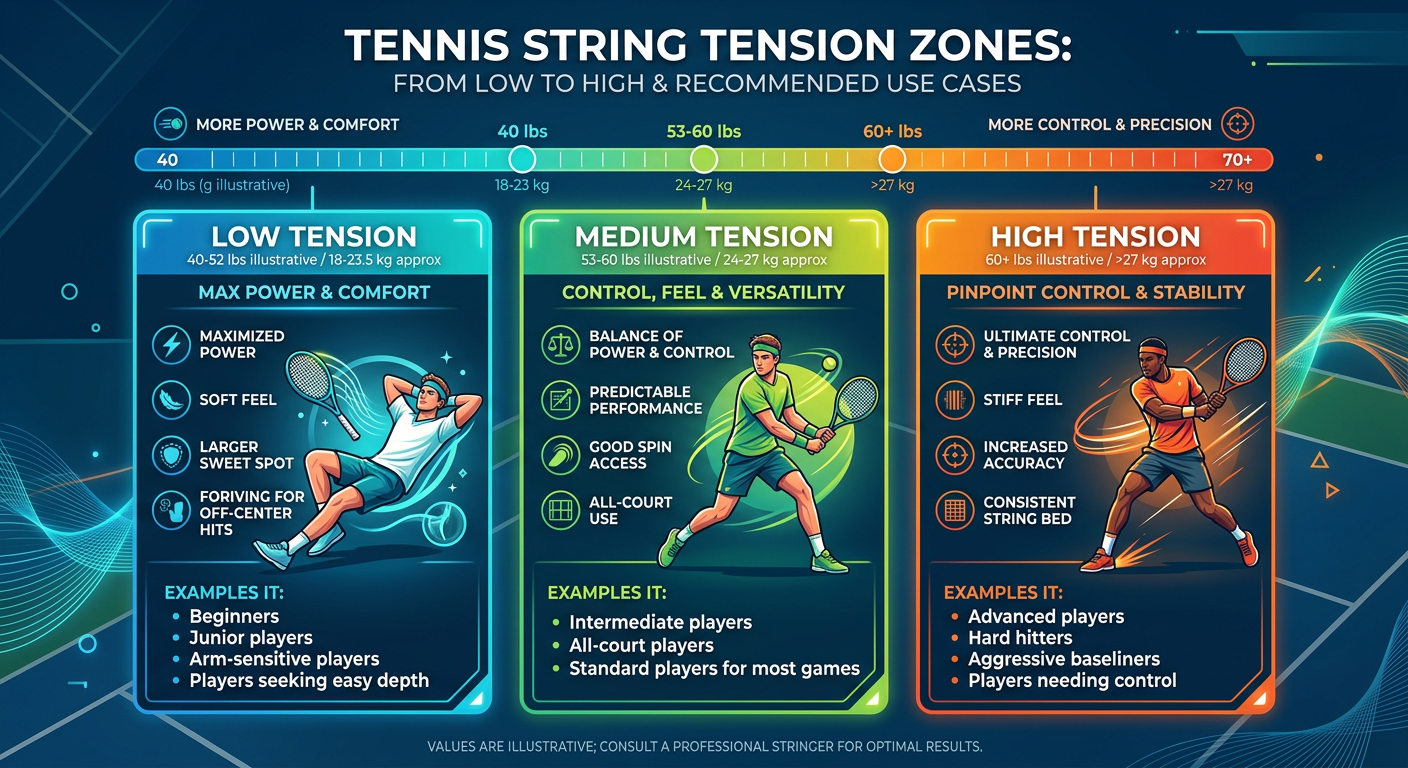
| Tension Zone | Feel | Best For | Risk |
|---|---|---|---|
| Below recommended range | Very powerful, trampoline feel | Players who lack pace | Ball control issues |
| Lower end of range | Powerful, comfortable | Arm-sensitive players, beginners | Most recreational players should try here |
| Middle of range | Balanced | General recreational play | Best starting point |
| Upper end of range | Controlled, precise | Aggressive hitters with good technique | More arm stress |
| Above recommended range | Very controlled, dead feel | Not recommended for most | High arm injury risk |
String Types Matter as Much as Tension
Before adjusting tension, consider switching string types. Research compiled by sports medicine sources including the Mayo Clinic Sports Medicine highlights that string type has a larger effect on feel and arm stress than tension alone for most recreational players.
🥇 Multifilament — Best for Recreational Players
The sweet spot for recreational players. Comfortable, lively, and easy on the arm. HEAD Velocity MLT and Wilson NXT are the benchmark recommendations. If you’re a recreational player who plays 1–4 times per week and has any concern about arm comfort, this is your string type.
Best for: Most recreational players. Default recommendation for anyone uncertain.
🥈 Polyester (Poly) — What Most Pros Use
Durable, spin-friendly, but stiff and arm-unfriendly. What most ATP and WTA professionals play with — and why so many of them have strict warm-up and cool-down protocols. Not ideal for recreational players unless you already have strong technique and no history of arm issues.
Best for: Advanced club players with consistent technique, players who break strings frequently. Avoid if you have any history of tennis elbow.
🥉 Natural Gut — The Most Comfortable String Made
The most comfortable string ever manufactured — and the original tennis string, invented by Babolat in 1875. Expensive (~$50–80 per string job) but worth it for players with serious arm sensitivity who haven’t found relief in multifilament. Tension holds longer than any other string type. Roger Federer played natural gut for his entire career.
Best for: Players with persistent arm issues, performance-focused recreational players who want the best feel available, players willing to pay premium for comfort.
4. Synthetic Gut — The Budget Middle Ground
Budget-friendly middle ground. Fine for beginners but worth upgrading when you play regularly. Wilson Synthetic Gut is the most common starter string and what most rackets come pre-strung with from the factory.
Best for: Beginners, players on tight budgets, players unsure how often they’ll play.
String Gauge — The Other Variable Nobody Talks About
String gauge refers to the thickness of the string. It’s typically labelled in numbers — the higher the number, the thinner the string.
- 15g (1.40mm): Thickest, most durable. Best for string breakers.
- 16g (1.30mm): Standard recreational thickness. Good balance of durability and feel.
- 17g (1.25mm): Thinner, livelier feel, more spin potential. Less durable.
- 18g (1.20mm): Thinnest, maximum feel and spin. Breaks quickly. Mostly for advanced players.
For most recreational players: 16g is the right starting point. Thicker if you break strings frequently. Thinner only if you’re chasing maximum feel and accept faster breakage.
Signs Your Tension is Wrong
Tension too high: Arm soreness after playing, ball feels dead off strings, spraying balls long, decreased depth on groundstrokes.
Tension too low: Hitting everything long, ball trampolines off strings, control disappears on fast balls, no feel for the ball.
How Often Should You Restring?
Most recreational players restring far less often than they should. Dead strings lose tension and transmit significantly more shock to your arm — a leading cause of tennis elbow in recreational players, as documented by the USTA in their player health resources.
The simple rule: Restring as many times per year as you play per week. Play once per week — restring once per year. Play three times per week — restring three times per year. This applies even if your strings haven’t broken — strings die from tension loss, not just from breakage.
Where to Get Restrung in Canada
Most tennis clubs in Canada offer restringing services through their pro shop or affiliated stringer. Costs typically range from $25–$45 CAD per string job, plus the cost of strings ($10–$80 depending on type). Premium racket retailers like Tennis Express, Merchant of Tennis (Toronto), and Pacific Sports (Vancouver) all offer professional restringing.
If you play frequently and want to save money long-term, consider buying your own stringer. Entry-level drop-weight stringers start around $200 CAD on Amazon and pay for themselves within 10–15 string jobs.
My Recommendation
Start with a quality multifilament string at the middle of your racket’s recommended tension range, in 16 gauge. Restring every 3–4 months if you play weekly. You’ll immediately notice improved feel and better arm comfort over the dead strings most recreational players are unknowingly playing with.
🎾 Stop Overthinking. Start Playing.
String tension is important. But not as important as actually showing up and hitting the ball. The “Just shut up and serve” T-shirt from LooseTennisBalls is for players who get it — sometimes you just need to stop overthinking and start playing.
Related Reading
- Best Tennis Rackets for Recreational Players (2026)
- Tennis Elbow Prevention and Treatment
- HEAD vs Wilson vs Babolat Brand Guide
- How to Improve Your Tennis Serve in 30 Days
Frequently Asked Questions
What tension should I string my tennis racket at?
Start at the middle of your racket’s recommended tension range — printed on the throat of the racket. For most recreational players, this means 52–56 lbs (24–25 kg). Lower tension increases power and comfort but reduces control. Higher tension increases control but reduces power and increases arm stress.
How often should I restring my tennis racket?
The rule of thumb: restring as many times per year as you play per week. Strings lose tension over time even if they don’t break — dead strings perform worse than fresh strings and increase arm injury risk. For recreational players playing once a week, restring once per year minimum.
What’s the best string for tennis elbow?
Multifilament strings (HEAD Velocity MLT, Wilson NXT) at lower tensions — 50–54 lbs — are the recommended starting point for tennis elbow sufferers. Natural gut is the most comfortable option but expensive. Avoid polyester strings entirely if you have any history of arm issues.
Does string tension really affect arm comfort?
Significantly, yes. Higher string tension transmits more shock to your arm on contact. Combined with stiff string types like polyester, high tension is one of the leading equipment causes of tennis elbow. Lowering tension by 4–6 pounds can dramatically reduce arm stress without major impact on playability.
Can I restring my own tennis racket?
Yes — entry-level drop-weight stringers cost around $200 CAD and become cost-effective after 10–15 string jobs. There’s a learning curve (your first 2–3 string jobs will look amateurish), but it’s a manageable skill. For recreational players who play 2+ times per week, owning a stringer makes financial sense long-term.
What gauge tennis string should I use?
16 gauge (1.30mm) is the recreational standard and the right starting point for most players. Move to 17 gauge (1.25mm) for more feel and spin if you don’t break strings frequently. 15 gauge (1.40mm) only if you break strings often and want maximum durability.