
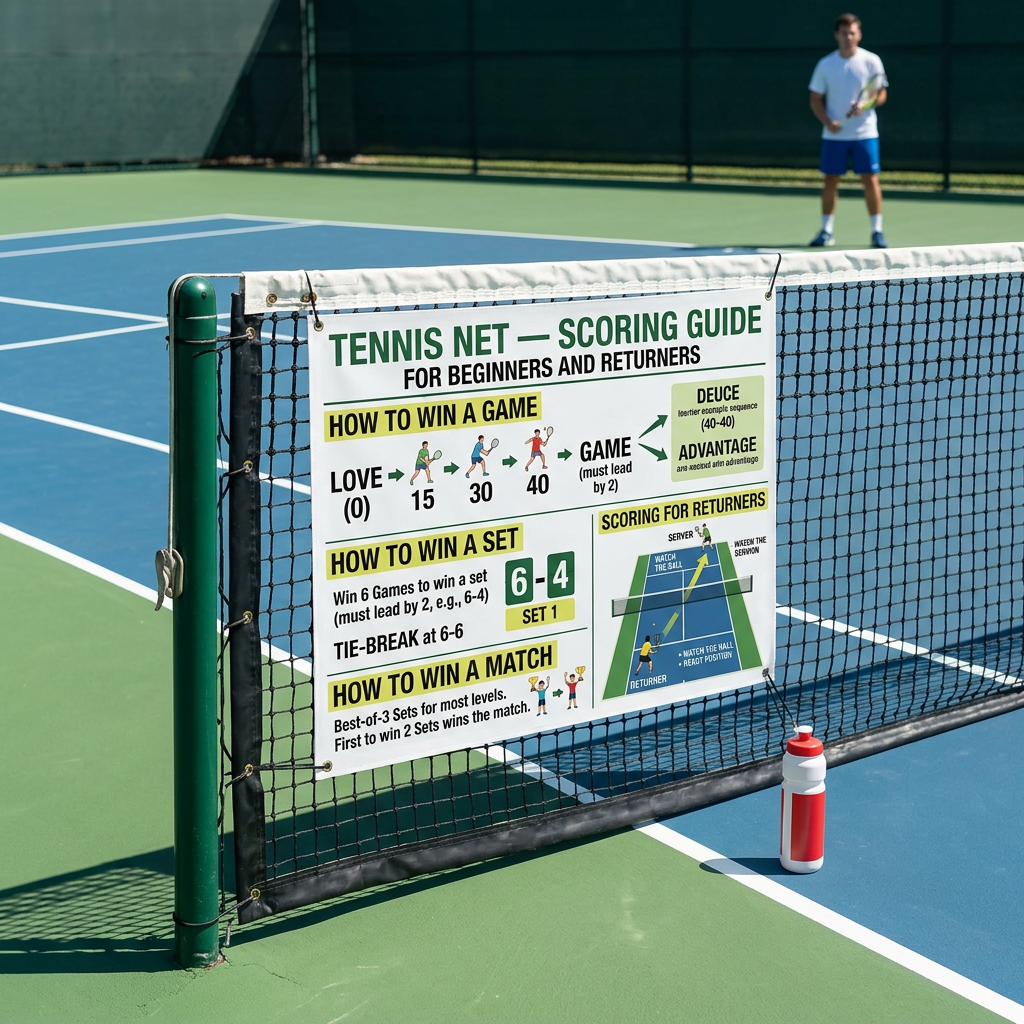
Tennis scoring seems completely arbitrary until someone explains the logic — and then it clicks. Whether you are brand new or returning after a long break, this guide covers everything you need to know.
🎾 Quick context
The terms “love” (zero) and the 15-30-40 system are believed to originate from clock faces and medieval French culture. The ITF now governs official scoring rules worldwide.
How Points Work
| Score | Called As | Meaning |
|---|---|---|
| 0 | Love | No points scored yet |
| 1 point | 15 | First point won |
| 2 points | 30 | Second point won |
| 3 points | 40 | One more point wins the game |
| Both on 40 | Deuce | Must win 2 consecutive points to win |
| 1 ahead after deuce | Advantage | One point from winning the game |
Points are always called server first. “30-15” means the server has 30 and the returner has 15.
Games, Sets and Matches
- Win 4 points → win a game
- Win 6 games (by 2) → win a set
- Win 2 sets → win the match (recreational standard)
What is a Tiebreak?
When a set reaches 6-6, most recreational matches play a tiebreak. First to 7 points, winning by 2. Points count 1, 2, 3 — not 15, 30, 40. Player A serves point 1, then player B serves points 2 and 3, then alternate every 2 points.
Deuce and Advantage
When both players reach 40-40, one player must win two consecutive points to win the game. Win the next point and you have “advantage.” Win the one after that and you win the game. Lose it and it returns to deuce. Many recreational players use “no-ad” scoring — next point after deuce wins — to keep things moving.
Common Scoring Mistakes
- Forgetting the score mid-game — call the score before every serve, every time
- Calling “out” late — call immediately or give the benefit of the doubt
- Disagreeing on deuce count — if unsure, replay the point
Now that scoring is sorted, check out our complete guide for adults starting tennis and make sure you have the right racket for recreational play. 🎾