Most recreational tennis players approach fitness backwards. They either do nothing and wonder why they’re gassed after a third set, or they run 5K three times a week and wonder why it doesn’t help on court. Tennis fitness is specific — and the specificity is the whole point. Here’s the guide for recreational players who want to actually be fitter on court without training like a touring professional.
Why Generic Cardio Doesn’t Transfer to Tennis
A 5K run takes 25–35 minutes of sustained aerobic effort at roughly 60–70% of maximum heart rate. A tennis point at recreational level lasts 4–8 seconds, with 20–30 seconds of rest between points. This is not aerobic endurance — it’s repeated explosive effort with short recovery.
Running more 5Ks will improve your aerobic base. It will not improve your ability to sprint for a drop shot, recover laterally, and sprint again 30 seconds later. That pattern requires interval training and lateral movement work — neither of which a jog addresses.
| Fitness Type | What It Develops | Tennis Relevance |
|---|---|---|
| Long slow cardio (5K+) | Aerobic base, recovery between games | Moderate — helps 3rd set endurance |
| Interval running | Repeated sprint recovery | High — matches tennis energy system |
| Lateral agility | Court coverage, split step efficiency | Very high |
| Rotational strength | Groundstroke power, serve speed | Very high |
| Grip and wrist stability | Injury prevention, volleys | High |
The Recreational Player’s Reality
You play twice a week. You have 30–45 minutes for fitness work between sessions. You are not a touring professional. Here’s what those 30 minutes should look like:
The Four Pillars of Tennis Fitness
1. Interval Running (10 minutes)
Sprint 10 seconds, walk 20 seconds. Repeat 15 times. This directly simulates the work-to-rest ratio of tennis at recreational level — and it’s finished in under 10 minutes. More effective for court performance than a 40-minute steady jog.
2. Lateral Movement (8 minutes)
Shuffle drill: from centre mark, shuffle to the singles sideline, back to centre, to the opposite sideline, back. Repeat for 8 minutes with 20-second breaks every 4 shuffles. This builds the hip abductor strength and lateral agility that tennis requires. Almost no recreational player does this and almost every recreational player needs it.
3. Rotational Core (7 minutes)
Medicine ball rotational throws (or standing rotations with a light dumbbell) build the core rotational strength that drives groundstroke power. Two sets of 20 rotations each direction. The serve, forehand, and two-handed backhand all draw from hip and core rotation — gym chest presses don’t develop this.
4. Tennis Elbow Prevention (5 minutes)
Wrist curls, reverse wrist curls, and forearm pronation/supination with a light dumbbell. Most recreational players don’t do this until after they’ve developed tennis elbow. Do it before. See our tennis elbow guide for the full prevention protocol.
The Warm-Up Problem
Most recreational players arrive at the court cold, hit a few balls, and then wonder why their first three games feel sluggish. A proper warm-up takes 8–10 minutes and involves dynamic movement before hitting a single ball — leg swings, hip circles, lateral shuffles, light arm circles. See the full tennis warm-up routine for the complete protocol.
The warm-up is not a fitness protocol — it’s injury prevention. Players who skip it injure themselves more often, perform worse in the first set, and feel worse after matches. It’s the most return-on-investment 10 minutes in recreational tennis.
Strength Training: What Transfers and What Doesn’t
| Exercise | Court Transfer | Why |
|---|---|---|
| Lateral lunges | Very high | Hip abductor and glute strength for lateral movement |
| Romanian deadlift | High | Hamstring and lower back stability for low ball retrieval |
| Shoulder external rotation | High | Rotator cuff health and injury prevention |
| Rotational med ball throws | Very high | Direct serve and groundstroke power development |
| Bench press | Low | Chest strength isn’t a tennis limiting factor |
| Bicep curls | Low | Arm strength isn’t the bottleneck in recreational tennis |
| Core planks | Moderate | Stability without rotational specificity |
The theme: unilateral movements, rotational strength, and lateral loading transfer well to tennis. Bilateral, sagittal plane gym staples (bench press, squat, bicep curl) are fine general fitness but don’t move the needle on court performance.
Hydration and Nutrition: The Part Recreational Players Ignore Most
Tennis is a 90–180 minute activity in variable Canadian summer heat. Recreational players consistently under-hydrate — showing up with a 500ml water bottle for a two-hour match is inadequate, especially when temperatures exceed 25°C.
Practical protocol:
- 500ml water in the 30 minutes before play
- 250ml per set (every 6–8 games), minimum
- Electrolytes (not sports drink — electrolyte powder mixed in water) for sessions over 90 minutes or in heat above 25°C
- No caffeine without carbohydrate within an hour of play — coffee-only pre-match hydration accelerates dehydration
A banana or similar carbohydrate snack eaten 30 minutes before a long match reduces third-set fatigue measurably. Not necessary for a social hitting session, genuinely useful for a competitive match.
🎾 Fitness Without Equipment
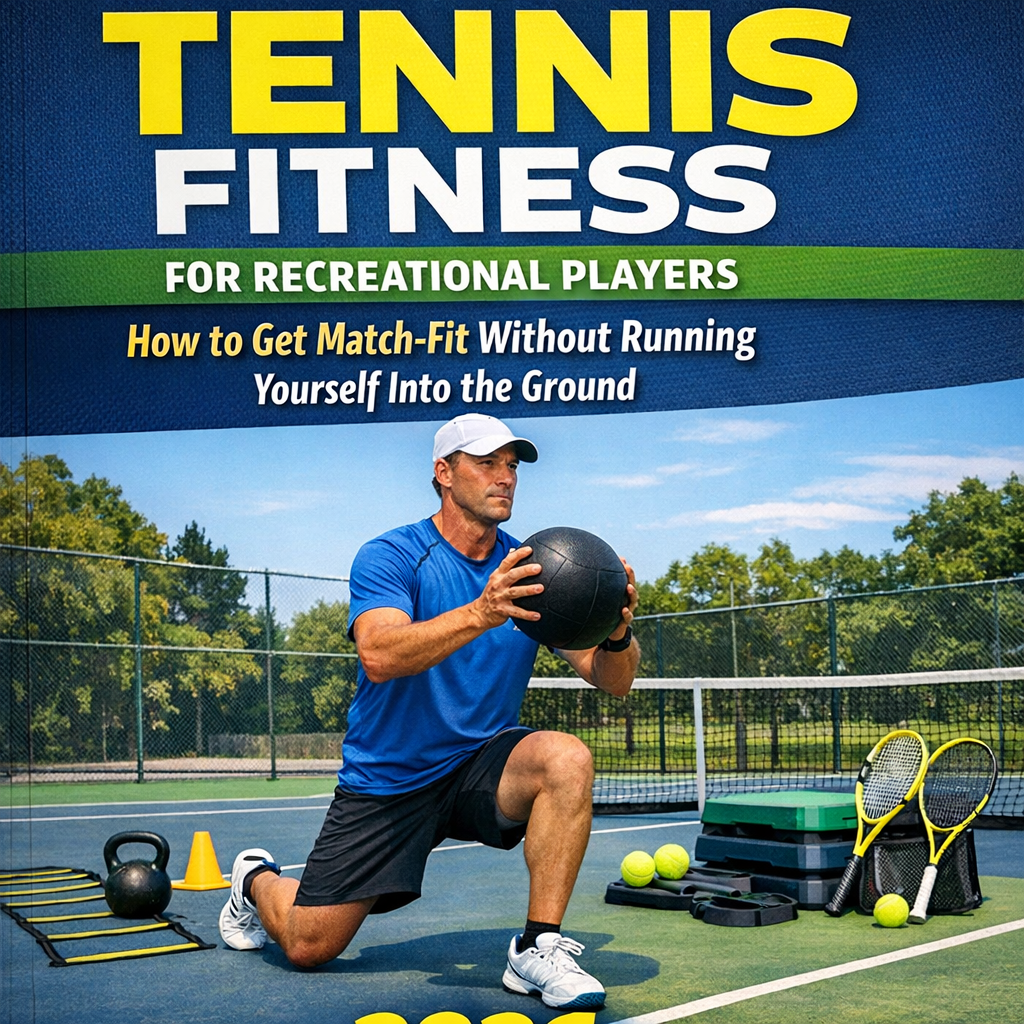
The tennis training aids guide covers the solo practice tools that build court fitness alongside technique — a resistance band set, a speed ladder, and a medicine ball address three of the four fitness pillars above for under $100 CAD total.
The Realistic Fitness Plan: 6-Week Block
For recreational players who want measurable improvement in 6 weeks:
Week 1–2: Establish the warm-up routine before every session. Add 10 minutes of interval running on off-court days.
Week 3–4: Add lateral shuffle drills (8 minutes) to the interval sessions. Begin wrist and forearm work (5 minutes) three times per week.
Week 5–6: Add rotational core work. Reduce steady-state cardio if you’ve been doing it. Reassess your hydration protocol.
By week 6, players who follow this consistently report feeling meaningfully less fatigued in the third set and moving better laterally. Not because the programme is exotic — because the specificity is right.
Related Reading
- Tennis Elbow Prevention and Treatment
- Tennis Warm Up Routine
- Best Tennis Training Aids 2026
- Why Recreational Tennis Players Plateau — And How to Break Through
Frequently Asked Questions
How do I get fitter for tennis without running long distances?
Interval training transfers to tennis far better than steady-state running. Sprint 10 seconds, rest 20 seconds, repeat 15 times. This matches the work-to-rest ratio of recreational tennis and improves repeated sprint performance, which is what you’re actually depleting during a match. Lateral shuffle drills address court coverage specifically.
How much should I train outside of tennis to improve my fitness?
For recreational players who play twice a week, 2–3 additional sessions of 30–40 minutes each is sufficient to see measurable improvement. More isn’t necessarily better — recovery matters, and adding significant training volume while also playing tennis increases injury risk. Focus on quality and specificity rather than volume.
Does stretching help tennis fitness?
Dynamic stretching before play helps performance and reduces injury risk. Static stretching (holding stretches) after play helps recovery and maintains flexibility. The research on static stretching before play is mixed — the current evidence suggests dynamic warm-up (leg swings, hip circles, light movement) is more effective than static stretching as pre-match preparation.
What should I eat before a tennis match?
A light carbohydrate meal or snack 1–2 hours before play is optimal. Good options: banana, toast with peanut butter, oatmeal, or a light pasta meal if playing in the evening. Avoid heavy protein meals within 2 hours — they’re slower to digest and can cause discomfort during lateral movement. Caffeine is fine if you’re habituated to it — just pair it with carbohydrates and hydration.
The Bottom Line
Tennis fitness for recreational players is about specificity, not volume. Interval training over long jogs. Lateral work over chest presses. Rotational core over planks. Warm up every time. Hydrate properly. Do the forearm work before your elbow tells you to. Six weeks of specific work beats six months of generic gym effort for on-court performance. 🎾