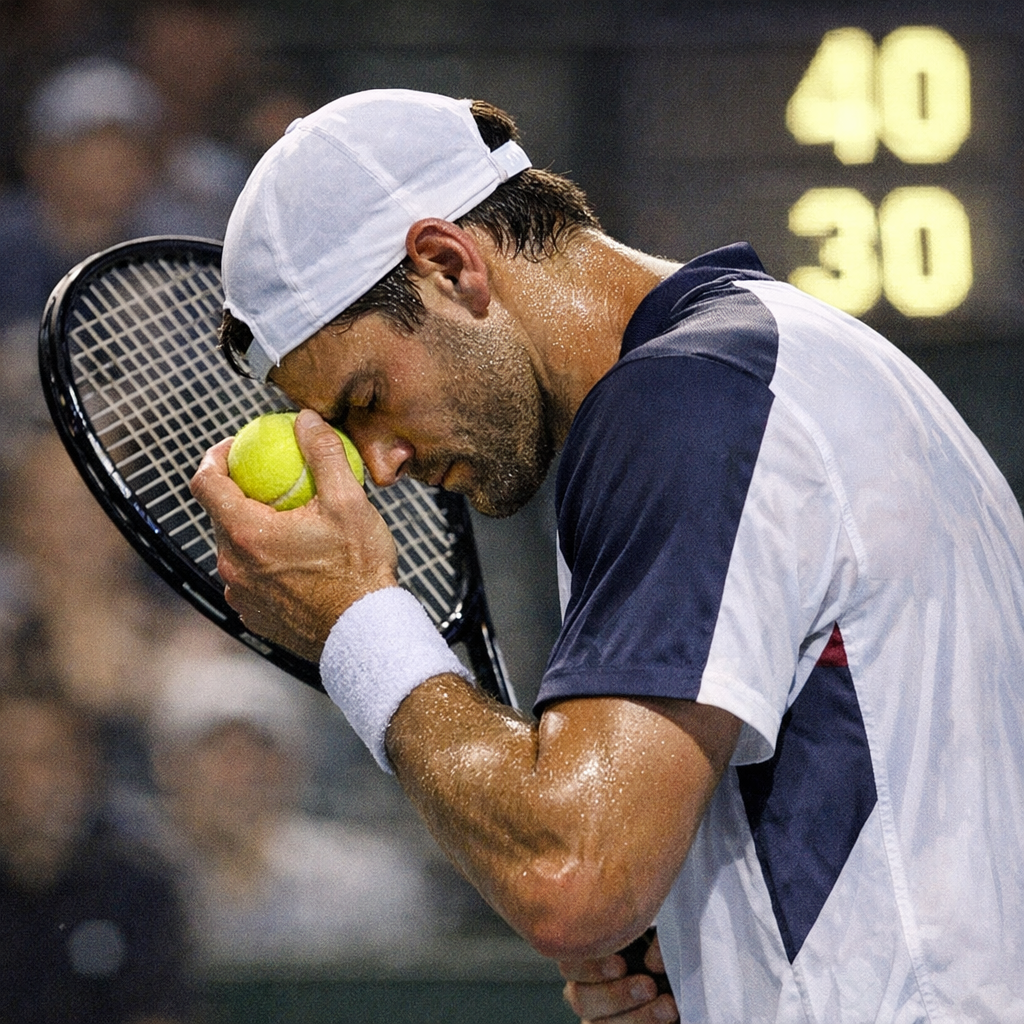
Double faulting under pressure is the universal recreational tennis nightmare. You serve fine in warmup. You serve fine in the first game. Then it’s 4-5, 30-30 in the second set, and your serve has decided to take an extended vacation. Suddenly you’re hitting balls into the back fence and apologising to your opponent. After 25 years of solving (and failing to solve) this exact problem, here’s the honest guide to stopping double faults under pressure in 2026.
First: Understand What’s Actually Happening
Double faulting under pressure is rarely a technical problem. Your technique didn’t suddenly forget how to serve — it’s still there. What’s happening is a measurable physiological response: nerves cause shallow breathing, increased heart rate, muscle tension, and disrupted timing. Your body is doing exactly what bodies do under stress. The serve is just the casualty.
Sports psychology research from sources including the USTA Player Development consistently identifies the serve as the shot most affected by competitive pressure — because it’s the only shot where you have complete control and complete responsibility for the outcome.
The 7 Causes of Pressure Double Faults
1. Toss Becomes Tentative
Under pressure, you toss the ball more carefully. Carefully = lower than usual. Lower toss = rushed swing = poor contact = ball goes into the net or long. The toss is the foundation — when it changes, everything changes.
2. Swing Speed Slows
Wanting to “place” the serve makes you decelerate the racket. Slower racket = less spin = ball doesn’t drop into the box = long fault. The serve requires acceleration through contact. Decelerating ruins everything.
3. Wrist Tightens
Tense wrist eliminates the wrist snap that creates pace and spin. Without snap, the ball has no spin to bring it down — it sails long or floats slow into the net.
4. You Start “Aiming” Instead of Hitting
Under pressure, you try to consciously direct the ball to a specific spot. This requires interrupting the natural swing motion to make micro-adjustments mid-swing. The result is mechanical, jerky, and unreliable. Trust your training and let the swing happen.
5. Body Rotation Disappears
Pressure makes you feel small. You arm-only the serve instead of using full body rotation. Less power, less spin, less control. The body must rotate through the serve for proper acceleration.
6. Breathing Stops
Most players hold their breath during the serve under pressure without realising it. Held breath = tense body = rigid swing. Breathing during the serve motion (exhale on contact) is one of the most overlooked anti-double-fault techniques.
7. You Speed Up the Service Routine
Nervous players rush the serve to “get it over with.” Fast service motion = no rhythm = no consistency. The pre-serve routine should be the same speed under any pressure level. Slow it down deliberately when you’re nervous.
The 5 Anti-Double-Fault Techniques That Actually Work
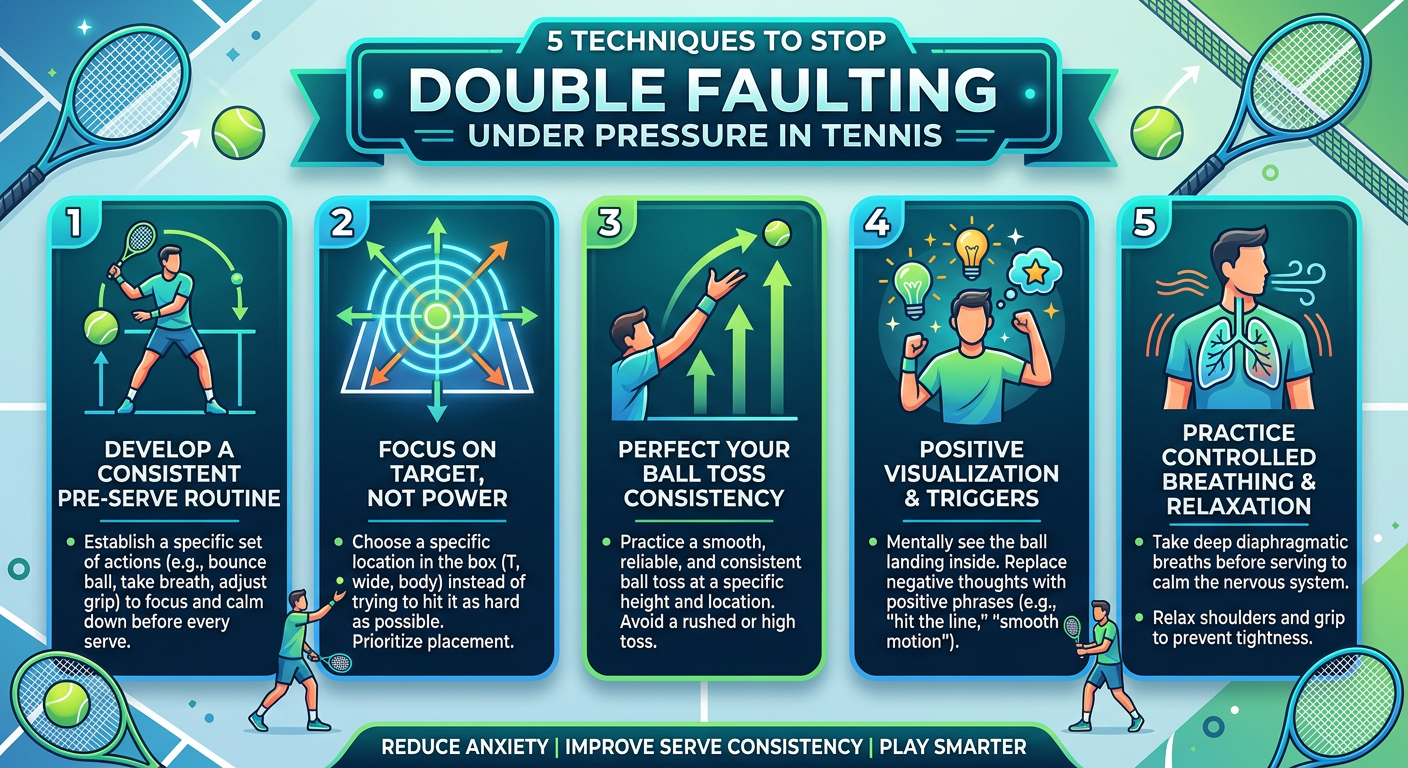
Technique 1: The Pre-Serve Routine (Non-Negotiable)
The single most effective anti-double-fault tool is a consistent pre-serve routine. Bounce the ball the same number of times every serve. Take the same breath. Use the same stance. Look at the same target. Routine creates consistency. Consistency overcomes nerves.
Your routine should take 6–10 seconds and never vary. Whether it’s 0-0 or 5-6 in the tiebreak, identical routine. This is the foundation everything else builds on.
Technique 2: Slow Down 20%
When nervous, deliberately reduce your serve pace by 20%. Hit at 70-75% instead of 90-95%. Pace doesn’t win matches — consistency does. A reliable 70% first serve in is dramatically more valuable than a 95% serve that’s a coin flip to land in.
Pros do this constantly. Watch any close ATP or WTA match — the second serve under pressure is rarely a maximum-effort kick serve. It’s usually a 75% pace serve with heavy spin and high net clearance.
Technique 3: Aim for the Service Box, Not a Target Within It
Under pressure, simplify your target. Don’t try to hit the corner. Don’t try to ace them down the T. Hit anywhere in the service box. The whole box. Mental simplification reduces pressure response and dramatically improves consistency.
Technique 4: Breathe Through the Serve
Inhale during the toss. Exhale through contact. Conscious breathing prevents the held-breath tension that ruins serves under pressure. Many top players exhale audibly during their serve — Maria Sharapova’s grunting was partly conscious breath release.
Technique 5: The “Process” Trigger Word
Choose a single word that focuses you on the process rather than the outcome. “Toss.” “Smooth.” “Spin.” Say it (silently or audibly) right before your service motion. The word redirects mental focus from “don’t double fault” to a specific physical action you can execute.
Practice Drills That Build Pressure Resistance
Drill 1: Consecutive Serves Under Self-Imposed Pressure
Practice serving in pressure-mimicking conditions. Set a goal: 5 consecutive first serves in before you can take a water break. Or 3 consecutive serves to a specific half of the box. The artificial pressure in practice translates to real pressure in matches.
Drill 2: Score-Calling Practice
Have your hitting partner call out match scores while you serve. “30-40, set point against you.” “Match point.” Hearing the score creates micro-pressure that you can practice managing in low-stakes environments.
Drill 3: Target Hitting With Pressure Multipliers
Place targets in the service boxes. Score yourself: 1 point for hitting the box, 3 points for hitting the target, -2 points for a fault. Play “matches” against yourself to a set score. The point system creates pressure-mimicking competitive context.
When the Double Fault Is Actually Technical
Sometimes — not often — the problem is genuinely technical, not mental. Signs that you have a technique problem rather than a pressure problem:
- You double fault frequently in practice with no pressure
- Your second serve never has spin
- Your toss is consistently in the wrong location
- Your serve has no acceleration through contact
- You haven’t been coached on serve technique in years (or ever)
If this describes you, see our 30-day serve improvement guide for the technical foundation work that needs to happen first. Mental techniques only work on top of solid technique.
The Mindset Shift That Changes Everything
Here’s the truth most recreational players never accept: you are going to double fault. Even pros double fault — Coco Gauff has had matches with 15+ double faults at Grand Slam level. The goal isn’t to never double fault. The goal is to prevent the double fault spiral where one double fault leads to three more in the same game.
After a double fault: take a breath, return to your routine, focus on the next serve. Don’t think about the double fault. Don’t replay it. Don’t tell yourself “don’t double fault again.” The brain doesn’t process negatives well — “don’t double fault” gets heard as “double fault.” Replace with “smooth toss, full swing.”
🎾 Stop Thinking. Start Serving.
The mental game is real. So is the value of just shutting up and serving. The “Just shut up and serve” T-shirt from LooseTennisBalls is for players who finally got the message: less analysis, more execution.
Related Reading
- How to Improve Your Tennis Serve in 30 Days
- Complete Pre-Match Warm-Up Routine
- Best Tennis Rackets for Recreational Players (2026)
- 10 Thoughts Every Recreational Tennis Player Has During a Match
Frequently Asked Questions
Why do I double fault more under pressure?
Pressure causes measurable physiological responses: tense muscles, faster heart rate, shallow breathing, and disrupted timing. The serve is the shot most affected because it’s the only stroke where you have complete control and complete responsibility. The technical solution isn’t more practice — it’s pressure-management techniques that override the stress response.
How do I stop double faulting on second serves?
Three changes: slow your second serve down 20% from your first serve pace, add more spin (kick or slice rather than flat), and aim for the centre of the box rather than corners. Reliability over pace. Pros aim their second serves with massive net clearance and heavy spin — copy this approach.
Should I always hit kick serves on second serve?
Eventually yes — but only after you can hit them reliably in practice. Kick serves provide the highest net clearance and most reliable in-box rate, which is exactly what you need on a second serve. If you can’t yet hit a kick serve, a 70% pace flat serve with high net clearance is the temporary alternative.
What’s a good first serve percentage for recreational players?
Recreational players should aim for 55-65% first serve percentage. Below 50% means you’re trying to hit too hard or aiming too aggressively. Above 70% might mean you’re not pushing your first serve enough and could play more aggressively. Pros average 60-70% at the highest level.
How can I practice serving under pressure?
Create artificial pressure in practice: serve consecutive first serves before allowed water breaks, have a partner call out match scores while you serve, score yourself with point penalties for faults. The artificial pressure builds the same neural patterns you’ll need under real match pressure.
Does racket choice affect double faulting?
Indirectly yes. Heavier rackets create more arm fatigue over a long match, which contributes to deteriorating serve technique in later sets. A lighter racket like the HEAD Ti.S6 or Wilson Clash 100L can reduce serve fatigue significantly. See our racket weight guide for full details.
The Bottom Line
Double faulting under pressure is fixable. Build a consistent pre-serve routine, slow down 20% when nervous, simplify your target, breathe through contact, and use a process trigger word. The technique is already in your arms. The mental game is what unlocks it. 🎾