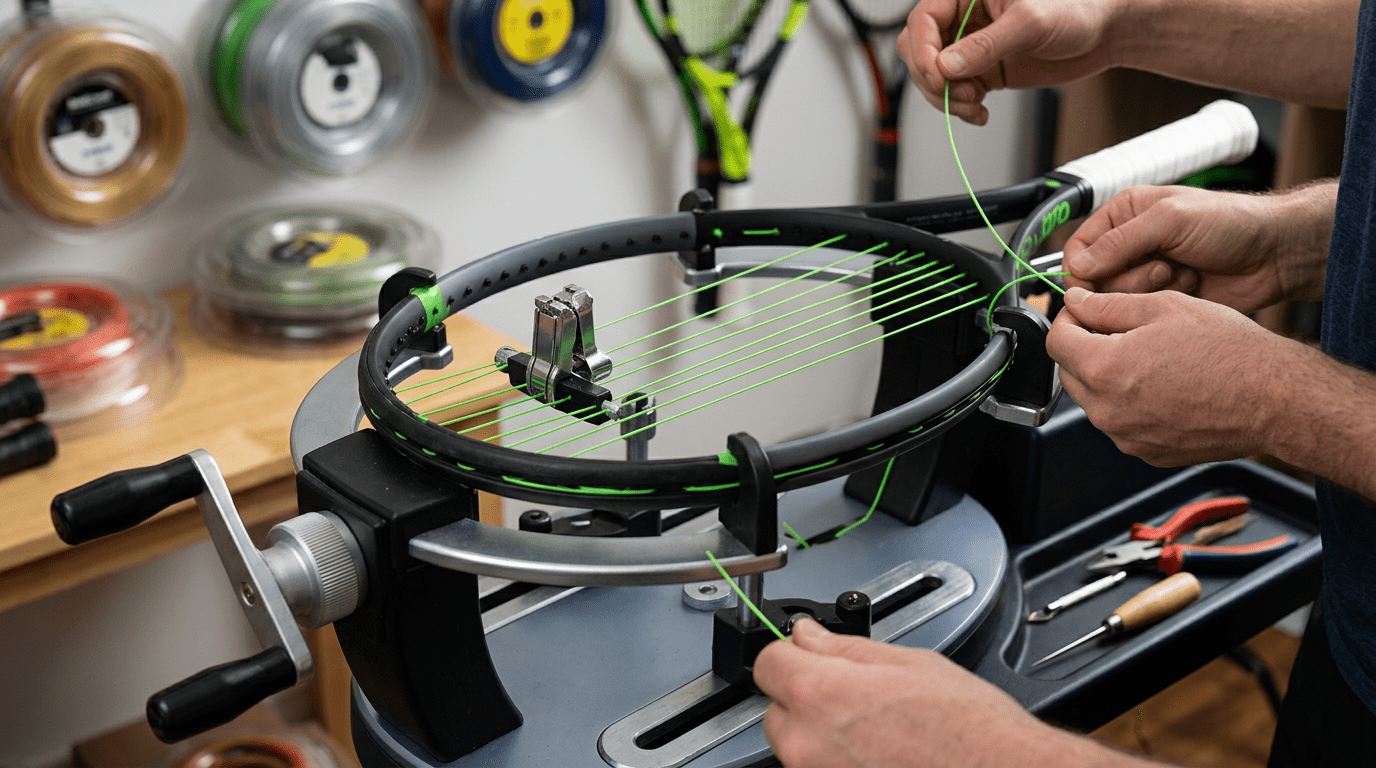
Most recreational players restring their racket when the strings break. This is wrong. By the time strings break, they’ve been dead for weeks — you’ve been playing with a frame that’s transmitting more shock to your arm, giving you less control, and performing worse than it should. Here’s everything you need to know about restringing your racket before your strings betray you.
How Often Should You Restring?
📊 The Rule of Thumb
Restring as many times per year as you play per week. Play twice a week? Restring at least twice per year. Play once a week? Once per year minimum. Most recreational players in Canada play twice a week and restring once every two years. That means they’re playing with dead strings for roughly 18 months out of every 24. This is a problem.
Signs Your Strings Are Dead
- The ball feels “thuddy” or “dead” off the strings — no pop
- You’re spraying balls more than usual with no technique explanation
- Your arm feels more tired than usual after playing — dead strings transmit more shock
- The strings have moved significantly out of alignment (main and cross strings noticeably offset)
- You’re hitting long more often on shots you used to control
- It’s been more than 6 months since your last restring and you play weekly
Choosing the Right Strings
This is the decision that matters most. For full guidance, read our complete tennis strings guide. The short version:
- Most recreational players: Multifilament (HEAD Velocity MLT or Wilson NXT) — comfortable, arm-friendly, good feel
- If you have tennis elbow: Multifilament at lower tension, or natural gut if budget allows
- If you break strings frequently: Polyester (Luxilon ALU Power, Babolat RPM Blast)
- Beginners: Synthetic gut is fine to start
Choosing the Right Tension
Every racket has a recommended tension range printed on the throat. Start in the middle of that range. For arm-sensitive players, go 3–5 lbs lower. For more control and you have consistent technique, go 2–3 lbs higher. See our string tension guide for the full decision tree.
How Much Does Restringing Cost in Canada?
| Service | Labour Only | Labour + Budget String | Labour + Premium String |
|---|---|---|---|
| Local pro shop | $15–$25 | $25–$40 | $45–$90+ |
| Big box sporting goods | $20–$30 | $30–$50 | $50–$80 |
| Online / mail-in | $10–$20 | $20–$35 | $40–$75 |
Local pro shops are almost always worth the price premium. They know rackets, they can advise on string choice for your game, and they typically use better stringing machines than big-box stores. Natural gut and premium hybrid setups should always go to a specialist stringer.
Can You Restring Your Racket Yourself?
Yes — but entry-level stringing machines start at $200–$400 CAD and the learning curve is real. The economics only make sense if you restring 3+ rackets regularly. For most recreational players, paying a pro shop $20–$30 in labour makes far more sense than buying and learning to use a stringer.
What to Tell the Stringer
When you drop your racket off, tell them: your playing level (recreational club player), how often you play, whether you have any arm issues, and roughly what you want — more power, more control, or more comfort. A good stringer will translate this into a string and tension recommendation. If they don’t ask any of these questions, find a different stringer.
After Restringing — What to Expect
Fresh strings feel different. More responsive. Slightly higher feel. If you’ve been playing with dead strings for months, the difference will be immediately noticeable. Give yourself 2–3 sessions to adjust to the new feel before changing anything — many players mistakenly think new strings are “too powerful” or “too stiff” before they’ve broken them in.
Also: replace your overgrip at the same time. There’s no point playing with fresh strings on a dead grip.
🎾 Fresh Strings, Fresh Attitude
Freshly strung racket. Fresh overgrip. The “I’m Not Arguing, Just Returning Your Serve” tee from LooseTennisBalls. You are ready.
Related Reading
- Best Tennis Strings for Club Players 2026
- Tennis String Tension Guide
- Tennis Elbow Prevention Guide
- Best Tennis Overgrips 2026
Frequently Asked Questions
How often should a recreational player restring their racket?
The standard rule: restring as many times per year as you play per week. A player who plays twice a week should restring at least twice per year. Most recreational players restring far less often — which means they’re playing with dead strings that reduce performance and increase injury risk for most of their playing time.
How much does it cost to restring a tennis racket in Canada?
Labour alone typically costs $15–$25 at a local pro shop. String cost adds $10–$70 depending on the string type. Total cost: $25–$40 for budget strings, $45–$90+ for premium multifilament or natural gut setups. Most recreational players can budget $40–$60 per restring for quality work.
What strings should I use when restringing?
For most recreational club players, a multifilament string (HEAD Velocity MLT or Wilson NXT) at the middle of your racket’s recommended tension range is the right answer. It provides comfort, good feel, and arm-friendly performance. Avoid polyester strings if you have any arm sensitivity. See our full strings guide for player-specific recommendations.
Can I tell when my strings need replacing without breaking them?
Yes. Signs of dead strings include a “thuddy” feel at contact, increased ball spraying, more arm fatigue than usual, and main strings that have shifted significantly out of alignment. The easiest test: compare the sound of your current strings against a freshly strung racket. Dead strings sound noticeably different.
The Bottom Line
Restring your racket more often than you do. It’s the highest-impact racket maintenance available, it directly reduces injury risk, and the performance difference between fresh and dead strings is immediately noticeable. Find a local pro shop you trust, commit to a regular restring schedule, and stop waiting for strings to break. 🎾