Tennis strings are the most important piece of equipment most recreational players completely ignore. You spent $200 on a racket. You’re playing it with whatever string the pro shop installed two years ago. After 25 years on the court — and dozens of string experiments — here’s what actually works for club players in 2026.
This isn’t a generic round-up. It’s specific recommendations for specific player types — beginners, intermediate club players, arm-sensitive players, and string breakers. By the end, you’ll know exactly which string to ask for at your next restring.
String Categories Every Club Player Should Know
| String Type | Feel | Durability | Arm Comfort | Cost (Canada) | Best For |
|---|---|---|---|---|---|
| Synthetic Gut | Standard | Good | Moderate | $8–$15 | Beginners, budget |
| Multifilament | Soft, lively | Moderate | Excellent | $15–$30 | Most club players |
| Polyester (Poly) | Stiff, controlled | Excellent | Poor | $10–$25 | String breakers, advanced |
| Natural Gut | Premium feel | Moderate | Best available | $40–$80 | Arm sufferers, performance |
| Hybrid (Poly + Gut/Multi) | Balanced | Good | Good | $20–$50 | Players wanting both |
The Best Tennis Strings for Club Players in 2026
🥇 1. HEAD Velocity MLT — Best Overall Multifilament
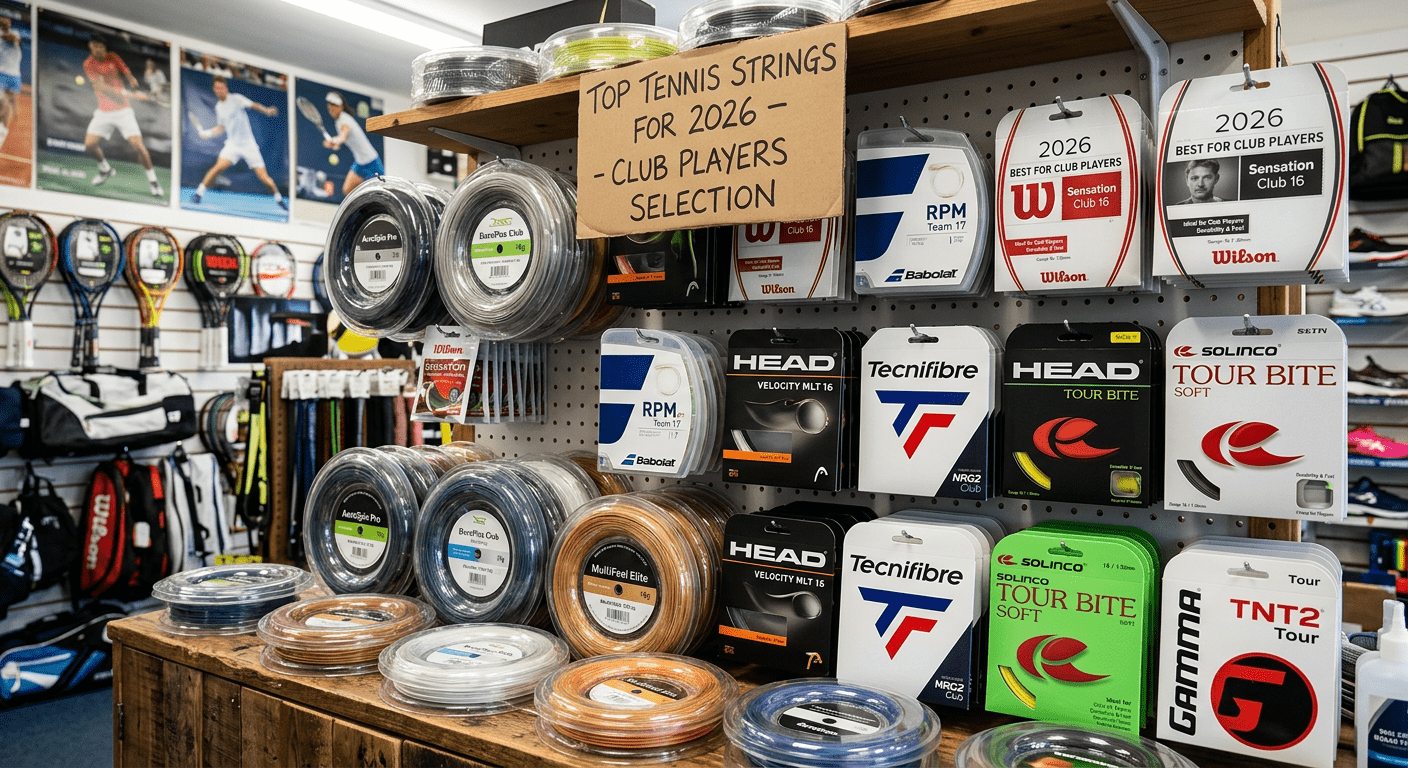
The honest answer for 80% of club players. HEAD Velocity MLT is a multifilament string that delivers comfort, decent power, and excellent feel without the arm-punishing stiffness of polyester. After years of experimenting with strings across the spectrum, this is what I keep coming back to for my recreational hitting.
Why it wins: Multifilament construction (hundreds of microfibres bundled together) creates a string that mimics natural gut at a fraction of the price. Excellent for arm comfort, lively off the strings, and consistent across its useful lifespan.
Best for: Recreational players who play 1–4 times per week, anyone with arm sensitivity, players who haven’t experimented with strings before.
Price (Canada): $15–$25 CAD per set | Gauge options: 16g, 17g
🥈 2. Wilson NXT — Best Premium Multifilament
Wilson’s flagship multifilament. Slightly more refined feel than HEAD Velocity, marginally better tension maintenance, and a touch more expensive. The choice for club players who want the multifilament experience refined to its highest level without crossing into natural gut territory.
Best for: Wilson racket loyalists, intermediate club players seeking premium feel, players who’ve outgrown basic multifilaments.
Price (Canada): $20–$30 CAD per set
🥉 3. Luxilon ALU Power — Best Polyester for Advanced Players
The polyester used by more ATP professionals than any other string. Stiff, durable, spin-friendly, and capable of generating serious power on aggressive strokes. Not for the faint of arm — but for the right player at the right level, nothing else compares.
Important caveat: Polyester strings transmit significantly more shock than multifilament. Players with any history of tennis elbow should avoid pure polyester setups entirely. See our tennis elbow guide before considering.
Best for: Advanced club players with consistent technique, players who break multifilament strings frequently, those who prioritise spin and control over comfort.
Price (Canada): $18–$25 CAD per set
4. Babolat RPM Blast — Best Spin-Friendly Polyester
The string in Carlos Alcaraz’s racket. The string in Rafael Nadal’s racket throughout his career. RPM Blast is the spin specialist — the octagonal cross-section bites the ball more aggressively than round polyesters, generating noticeably more topspin per swing.
Best for: Aggressive baseline players who hit with heavy topspin, Babolat racket users, players who want the closest feel to what’s used at the top of the pro game.
Price (Canada): $18–$28 CAD per set
5. Babolat VS Touch — Best Natural Gut
The original tennis string, invented by Babolat in 1875 and still the comfort benchmark. Natural gut delivers feel and arm comfort no synthetic string can match. Roger Federer played natural gut his entire career. Expensive, less durable than polyester, but unmatched for players who prioritise feel and comfort.
Best for: Players with persistent arm issues, performance-focused recreational players who want the best feel available, players willing to pay premium for comfort.
Price (Canada): $50–$80 CAD per set
6. Wilson Synthetic Gut — Best Budget Pick
The string most rackets come pre-strung with from the factory. Synthetic gut isn’t actually gut — it’s a single-filament nylon construction that delivers acceptable performance at the lowest price point. Fine for absolute beginners, casual players who play once a month, and budget-conscious players unsure how often they’ll actually play.
Best for: Beginners, very casual players, budget situations.
Price (Canada): $8–$15 CAD per set
Hybrid Setups: The Best of Both Worlds
Hybrid stringing — using one type of string for the main strings (vertical) and a different type for the cross strings (horizontal) — is increasingly popular at the club level. The most common setup: polyester mains for control and durability, multifilament or natural gut crosses for comfort.
Federer’s famous setup was natural gut mains + polyester crosses — the opposite of the typical hybrid. Both work for different players. Hybrids cost slightly more (you’re buying two string sets) but allow you to dial in the exact feel you want.
Which String Should You Choose?
- Total beginner: Wilson Synthetic Gut — affordable, adequate, no surprises
- Casual recreational player (1x per week): HEAD Velocity MLT — best balance of comfort and price
- Serious club player (2–3x per week): Wilson NXT or hybrid setup — premium feel, good durability
- Advanced club player with strong technique: Luxilon ALU Power or Babolat RPM Blast — control and spin focused
- Player with tennis elbow: HEAD Velocity MLT at lower tension, or Babolat VS Touch natural gut for serious cases
- String breaker: Polyester (Luxilon or RPM Blast) — durability over comfort
String Tension Matters Just as Much
The right string at the wrong tension performs worse than a mediocre string at the right tension. See our complete string tension guide for the full breakdown — the short version is start at the middle of your racket’s recommended tension range and adjust from there.
🎾 Stop Overthinking Your Strings
Got the strings sorted? Now stop researching and start playing. The “Just shut up and serve” T-shirt from LooseTennisBalls is for players who finally stopped reading string reviews and got back on court.
Related Reading
- Complete Tennis String Tension Guide
- Best Tennis Rackets for Recreational Players (2026)
- Tennis Elbow Prevention and Treatment
- HEAD vs Wilson vs Babolat Brand Guide
Frequently Asked Questions
What’s the best tennis string for club players?
HEAD Velocity MLT or Wilson NXT — both are multifilament strings that deliver excellent comfort, decent power, and good feel without the arm-punishing stiffness of polyester. These are the recommended starting points for 80% of club players in 2026.
Are polyester strings bad for your arm?
For recreational players, generally yes. Polyester strings transmit significantly more shock than multifilament, which is why they’re a leading contributor to tennis elbow in club players who copy what professionals use. Pros use polyester because they have professional bodies, daily massage, and customised arm-friendly frame setups. You don’t.
How often should I change my tennis strings?
The rule of thumb: restring as many times per year as you play per week. Strings lose tension over time even if they don’t break — dead strings perform worse than fresh strings and increase arm injury risk. For recreational players playing once a week, restring once per year minimum.
What strings does Roger Federer use?
Federer played a hybrid setup throughout his career: natural gut for the mains (Wilson Natural Gut) and polyester for the crosses (Luxilon ALU Power Rough). This combination delivered the comfort and feel of natural gut with the durability and spin of polyester. The setup is replicable for serious club players willing to pay $50–$80 CAD per restring.
What’s the difference between multifilament and synthetic gut?
Multifilament strings are constructed from hundreds of thin microfibres bundled together, mimicking the structure of natural gut. Synthetic gut is a single-filament nylon construction. Multifilament offers significantly better comfort, feel, and arm protection. Synthetic gut is cheaper but stiffer and less responsive.
Should I switch from synthetic gut to multifilament?
Yes — for any recreational player playing more than occasionally. The jump from synthetic gut to a quality multifilament like HEAD Velocity MLT or Wilson NXT is one of the most noticeable upgrades available in tennis equipment. You’ll feel the difference in arm comfort and ball response within the first session.
The Bottom Line
For most recreational players in Canada in 2026, the answer is HEAD Velocity MLT or Wilson NXT at the middle of your racket’s recommended tension range, in 16 gauge, restrung every 3–4 months if you play weekly. That setup will outperform 90% of what you see at your local club. 🎾