Hard courts are unforgiving. Concrete and asphalt surfaces generate ground reaction forces up to three times your body weight with every step — a figure confirmed by biomechanical research published in the British Journal of Sports Medicine. After 25 years of playing on hard courts, I’ve learned the expensive way that the wrong shoes don’t just hurt your game — they wreck your body.
This guide covers the best hard court tennis shoes available in Canada in 2026 — tested by a recreational club player who has worn through more pairs than he’d like to admit. Not general athletic shoes. Not running shoes. Hard court tennis shoes specifically.
If you’re currently playing tennis in running shoes, please read this entire article before your next match. Your knees are sending you a message and you’re ignoring it.
📊 Hard Court Tennis by the Numbers (2026)
• 60% of all professional tennis is played on hard courts — the most common surface on the ATP Tour
• 3x body weight ground reaction force on hard courts vs. 1.5x on clay (biomechanical research, BJSM)
• Tennis participation in Canada has grown over 40% since 2020, per Tennis Canada
• Sport-specific footwear significantly reduces lower-limb injury risk compared to running shoes (Mayo Clinic Sports Medicine)
Why Hard Court Shoes Are Non-Negotiable
Running shoes are engineered for forward motion — heel strike, toe-off, repeat. Tennis involves constant lateral movement, sudden stops, and explosive direction changes that running shoe soles are structurally incapable of supporting safely.
The difference in outsole design is the critical factor. Hard court tennis shoes use a herringbone or modified herringbone tread pattern that grips without catching — allowing controlled slides while preventing ankle roll. Running shoe soles catch on lateral movement and dramatically increase ankle sprain risk.
⚠️ Research published by the USTA Player Development consistently identifies improper footwear as a leading contributor to recreational tennis injuries — particularly ankle sprains and chronic knee pain. This isn’t marketing. This is biomechanics.
Beyond injury risk, hard court-specific shoes include reinforced toe caps (for the drag that destroys running shoe toes within weeks), extra lateral support in the midsole, and cushioning tuned for the impact frequency of tennis rallies rather than running stride rhythm.
What Makes a Great Hard Court Tennis Shoe in 2026
Before the picks, here’s the framework I use to evaluate hard court shoes — built from 25 years of trial, error, and one memorable ankle that still talks to me in cold weather.
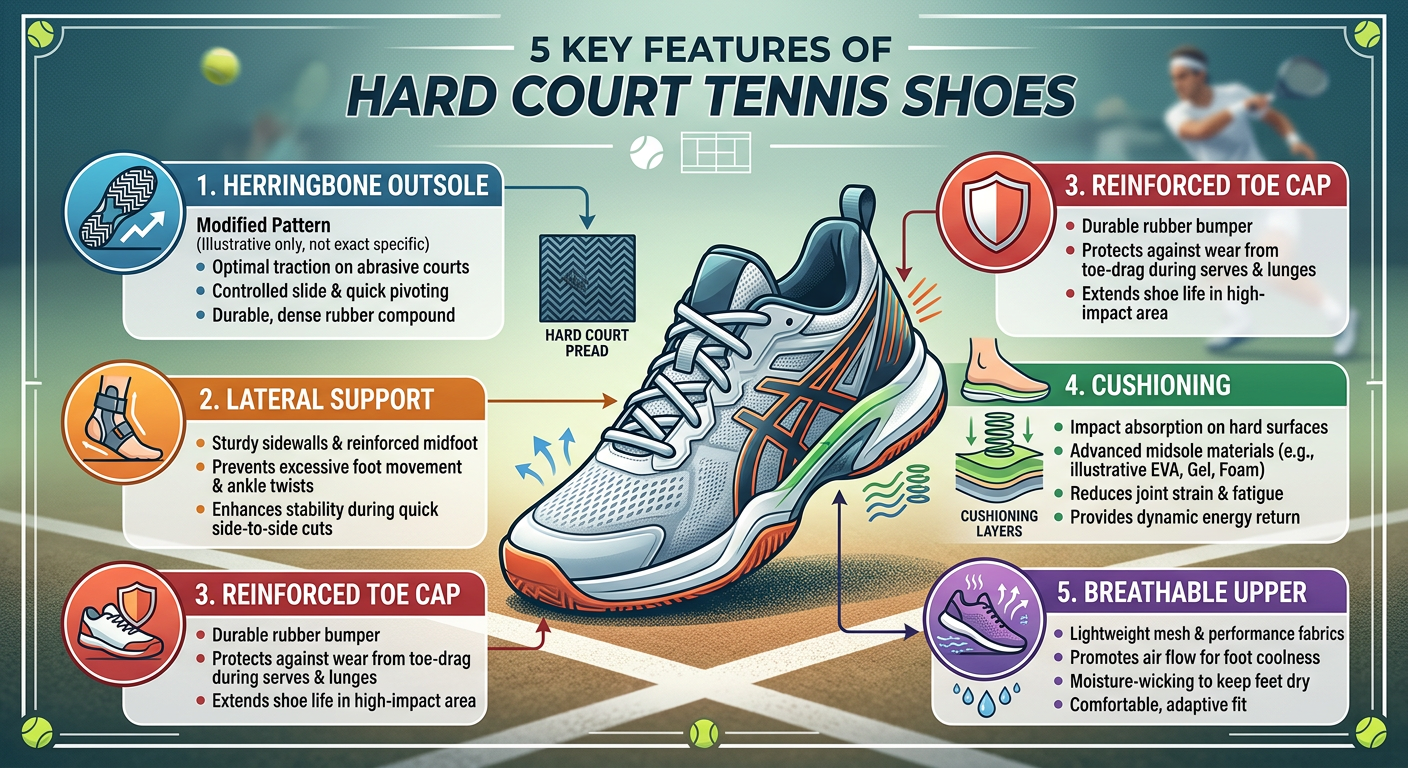
The five factors that separate great hard court shoes from expensive disappointments:
1. Outsole durability: Hard court abrasion destroys cheap outsoles within weeks. Look for high-density rubber compounds — ASICS uses their proprietary AHAR+ rubber on their better models, which genuinely lasts twice as long as standard rubber on asphalt.
2. Lateral support: This is where injury prevention lives. A reinforced lateral midsole wall prevents the ankle roll that ends recreational tennis seasons. Non-negotiable.
3. Cushioning system: GEL, Air, or foam-based systems all work differently. The key is that cushioning is tuned for multi-directional impact, not just vertical heel strike like in running shoes.
4. Fit and width options: Tennis shoes run differently across brands. ASICS and New Balance tend to run wider; Nike tends to run narrow. If your toes are compressed, your balance and movement are compromised.
5. Toe cap reinforcement: The drag-step on serves and volleys destroys the toe of any shoe not specifically reinforced for it. Most reputable tennis shoes include this; budget options often don’t.
The Best Hard Court Tennis Shoes in Canada (2026)
🥇 1. ASICS Gel-Resolution 9 — Best Overall Hard Court Shoe
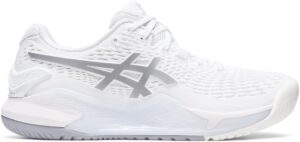
The Gel-Resolution has been the benchmark hard court tennis shoe for serious recreational players for over a decade, and the 2025 Generation 9 update earns that reputation again. I’ve worn through three pairs across five years and they have never let me down on any hard court surface in any Canadian weather condition.
The AHAR+ outsole rubber is genuinely superior for hard court longevity — ASICS rates it at twice the durability of standard rubber outsoles, and in my experience that tracks accurately. The GEL cushioning units in both heel and forefoot absorb impact progressively across long sessions — you feel the difference at the two-hour mark when your joints are still comfortable rather than screaming.
The Gel-Resolution 9 is worn on hard courts by players on the ATP Challenger circuit — not a sponsorship claim, but a genuine indicator of where the shoe sits on the performance spectrum. For recreational players, it’s arguably overbuilt — which is exactly why it’s the right choice.
Weight: ~350g | Width: Standard, Wide (2E) | Price (Canada): $160–$200 CAD | Outsole: AHAR+ rubber
✅ Pros: Exceptional durability, superior lateral support, excellent cushioning for long sessions, wide fit option
❌ Cons: Heavier than lightweight options, premium price, may feel stiff initially (allow 3–4 sessions to break in)
Best for: Most recreational players. If you’re playing 2+ times per week on hard courts and want one shoe that does everything well, this is it.
🥈 2. HEAD Sprint Pro 3.5 — Best for HEAD Loyalists
As someone who has committed to HEAD equipment for over two decades, the Sprint Pro earns its place here on merit rather than brand loyalty. The Sprint Pro 3.5 is the shoe family Novak Djokovic has worn during ATP hard court seasons — a player who has won more hard court Grand Slams than anyone in tennis history. That pedigree matters.
Where the Sprint Pro distinguishes itself is weight. At approximately 320g, it’s notably lighter than the ASICS Gel-Resolution without sacrificing meaningful lateral support. For players who feel heavy shoes slow their court movement, this is the trade-off worth making. The HydroGuard moisture management system also keeps feet notably drier through long sessions — a genuine differentiator in Canadian summer humidity.
Weight: ~320g | Width: Standard | Price (Canada): $150–$185 CAD
✅ Pros: Lightweight feel, excellent lateral support, strong moisture management, HEAD brand consistency
❌ Cons: No wide fit, slightly less cushioning than ASICS, narrower fit may not suit all foot shapes
Best for: HEAD loyalists, players who prioritise lightweight feel, players who run hot and need breathability.
🥉 3. Nike Air Zoom Vapor 11 — Best Lightweight Option
The Vapor series has been worn on hard courts by Carlos Alcaraz — currently world number one on the ATP Tour as of early 2026 — and has been a fixture at the highest level for years. The Vapor 11 is the lightest performance hard court shoe on this list at approximately 290g, and the Air Zoom unit in the forefoot delivers a responsive, springy feel that heavier shoes simply cannot replicate.
The trade-off is durability. Nike’s hard court outsole rubber is not as hard-wearing as ASICS AHAR+ — expect a shorter lifespan if you’re playing on rough asphalt rather than smoother club hard courts. For players on well-maintained club courts playing 2–3 times per week, this is manageable. For outdoor asphalt court warriors, the ASICS will outlast the Vapor significantly.
Weight: ~290g | Width: Standard (runs narrow) | Price (Canada): $170–$210 CAD
✅ Pros: Lightest shoe on this list, exceptional court feel, Air Zoom responsiveness, worn at the highest level of the sport
❌ Cons: Runs narrow, shorter outsole lifespan on rough courts, premium price
Best for: Players who feel slowed down by heavy shoes, those on smooth indoor or club hard courts, players who want to feel fast without sacrificing stability entirely.
4. New Balance Fresh Foam Lav v2 — Best for Wide Feet
If you’ve spent years squeezing your feet into standard-width tennis shoes and wondering why your toes go numb mid-match, New Balance is the answer the rest of the industry hasn’t properly addressed. The Fresh Foam Lav v2 comes in multiple widths — 2E and 4E included — making it the only serious option for players with genuinely wide feet who refuse to compromise on performance.
New Balance’s Fresh Foam midsole is genuinely excellent cushioning — plush without being mushy, which is the balance point that many foam midsoles fail to hit. The hard court outsole is durable and well-rated. This is not a compromise shoe for wide-footed players — it’s a genuinely excellent hard court shoe that also happens to fit feet that other brands pretend don’t exist.
Weight: ~370g | Width: Standard (D), Wide (2E), Extra Wide (4E) | Price (Canada): $140–$175 CAD
✅ Pros: Best width options in tennis shoes, excellent Fresh Foam cushioning, strong durability, competitive pricing
❌ Cons: Heavier than lightweight options, less lateral stiffness than ASICS, less widely stocked in Canadian retail
Best for: Players with wide or extra-wide feet, players with toe comfort issues in standard-width shoes, those who prioritise cushioning comfort.
5. K-Swiss Hypercourt Express 2 — Best Budget Pick
K-Swiss doesn’t get enough credit in the recreational tennis market. The Hypercourt Express 2 delivers legitimate hard court performance at a price point that makes every other shoe on this list look extravagant. For players returning to tennis after a long break, juniors whose feet are still growing, or anyone who simply doesn’t want to spend $180 on shoes for a sport they’re just getting back into — this is the honest recommendation.
The Hypercourt Express 2 includes a reinforced toe cap, solid lateral support, and a durable hard court outsole. It is not as cushioned as the ASICS or as lightweight as the Nike. But it provides everything a recreational player genuinely needs to play safely and comfortably at a fraction of the premium price. K-Swiss has been making tennis shoes since 1966 — they know what they’re doing.
Weight: ~340g | Width: Standard | Price (Canada): $85–$120 CAD
✅ Pros: Excellent value for money, all essential hard court features, clean design, great for beginners and returners
❌ Cons: Less cushioning than premium options, no wide fit option, shorter lifespan than ASICS or HEAD premium models
Best for: Players returning to tennis, budget-conscious recreational players, those wanting to try the sport before investing in premium footwear.
Best Hard Court Tennis Shoes for Women in 2026
All five shoes above are available in women’s versions. Women’s tennis shoes are not simply smaller men’s shoes — properly engineered women’s models account for anatomical differences including a narrower heel relative to forefoot width, different arch height distribution, and lower average body weight affecting cushioning requirements.
Top women’s picks for 2026:
- Best overall: ASICS Gel-Resolution 9 Women’s
- Best lightweight: Nike Air Zoom Vapor 11 Women’s
- Best value: K-Swiss Hypercourt Express 2 Women’s
Hard Court Tennis Shoe Comparison Table (2026)
| Shoe | Weight | Price (CAD) | Durability | Width Options | Best For |
|---|---|---|---|---|---|
| ASICS Gel-Resolution 9 | ~350g | $160–$200 | ⭐⭐⭐⭐⭐ | Standard, Wide | Overall best |
| HEAD Sprint Pro 3.5 | ~320g | $150–$185 | ⭐⭐⭐⭐ | Standard | Lightweight + HEAD fans |
| Nike Air Zoom Vapor 11 | ~290g | $170–$210 | ⭐⭐⭐ | Standard (narrow) | Speed-focused |
| New Balance Lav v2 | ~370g | $140–$175 | ⭐⭐⭐⭐ | D, 2E, 4E | Wide feet |
| K-Swiss Hypercourt 2 | ~340g | $85–$120 | ⭐⭐⭐ | Standard | Budget / beginners |
How Long Should Hard Court Tennis Shoes Last?
On hard courts, expect 3–6 months of lifespan playing 2–3 times per week — but the range is wide depending on court surface roughness, your playing style, and shoe quality. The outsole wears fastest and is your primary indicator.
Replace your shoes when you notice any of these:
- Outsole tread has worn smooth in the lateral forefoot area
- You feel ankle instability during side-to-side direction changes that you didn’t feel before
- Joint pain (knee or hip) starts appearing after sessions on surfaces that didn’t previously cause it
- The upper is separating from the midsole at any point
- The midsole feels noticeably compressed and flat rather than cushioned
Don’t wait until the upper falls apart. The cushioning and lateral support fail well before the exterior looks obviously worn. By the time your shoe looks dead, it’s been dead for a month.
Tennis Shoe Sizing Guide for Canadian Players
Tennis shoes should fit differently from running shoes or casual shoes. The general recommendation from USTA equipment guidelines is to size up half a size from your casual shoe size — your foot expands slightly during intense lateral movement, and toe compression during hard stops can cause real discomfort and even nail damage in a shoe that fits perfectly at rest.
Brand-specific sizing notes for Canadian buyers:
- ASICS: True to size, half-size up recommended for hard court play
- HEAD: Runs slightly narrow, consider half-size up if you have a wider foot
- Nike: Runs narrow — if between sizes, go up a full size
- New Balance: True to size across all widths — the most reliable sizing in tennis
- K-Swiss: True to size, slightly roomy in the toe box which many players prefer
🎾 Gear Up On and Off the Court
You’ve sorted your footwear. Now sort the rest of your kit. The “You’ve met your match” hoodie from LooseTennisBalls is the perfect off-court companion — because showing up with the right shoes and the right attitude is a complete package.
Complete Your Hard Court Setup
Shoes are one piece of the hard court puzzle. Make sure the rest of your kit is working as hard as your footwear:
- Best Tennis Rackets for Recreational Players in Canada (2026)
- HEAD vs Wilson vs Babolat — Which Brand is Right for You?
- Tennis Elbow Prevention and Treatment
- The Complete Pre-Match Warm-Up Routine
Frequently Asked Questions — Hard Court Tennis Shoes
Can I use running shoes for tennis on hard courts?
Technically yes — nothing stops you. But running shoes are designed exclusively for forward motion and provide no meaningful lateral support. Tennis requires constant side-to-side movement, and running shoe soles can catch on hard court surfaces during lateral direction changes, dramatically increasing ankle sprain risk. The honest answer: don’t do it.
How often should I replace my tennis shoes on hard courts?
For players playing 2–3 times per week on hard courts, plan for replacement every 3–6 months. The outsole wears fastest — once the herringbone tread pattern is smooth in the lateral forefoot area, your lateral support is compromised regardless of how the upper looks.
What is the best tennis shoe brand for hard courts in Canada?
ASICS consistently leads for hard court durability and overall performance, largely due to their proprietary AHAR+ outsole rubber. For lightweight feel, Nike’s Vapor series is the benchmark. For arm-friendly players or wide feet, New Balance is the honest recommendation. All are available through Amazon.ca with reliable delivery across Canada.
Should tennis shoes be a size bigger than normal?
Generally yes — a half size up from your casual shoe size is the standard recommendation for tennis. Your foot expands during intense lateral movement and hard stops, and toe compression in a shoe that fits perfectly at rest can cause real discomfort during play. Nike specifically tends to run narrow and may require a full size up.
What’s the difference between hard court and clay court tennis shoes?
Hard court shoes use a herringbone or modified herringbone outsole pattern designed for grip without catching on a firm, abrasive surface. Clay court shoes use a full herringbone pattern with a shallower tread that allows controlled sliding while preventing clay from packing into the tread. Always match shoe type to surface.
Are expensive tennis shoes worth it for recreational players?
Yes — with a qualifier. The jump from $85 to $160 in tennis shoes represents genuine performance and durability improvements that recreational players benefit from. The jump from $160 to $250 is mostly marginal gains that matter more to competitive players. The ASICS Gel-Resolution 9 at $160–$200 CAD hits the sweet spot for most recreational players.
The Bottom Line
The ASICS Gel-Resolution 9 is the right shoe for most recreational hard court players in Canada. It’s durable, supportive, well-cushioned, and available in a wide fit. It costs more than the K-Swiss — and it lasts significantly longer, which makes the maths work out in its favour over a season.
If you’re a HEAD loyalist, grab the Sprint Pro 3.5. If you prioritise feeling fast on court, the Nike Vapor 11 is worth the trade-off in durability. If your feet have never fit properly in standard-width shoes, the New Balance Lav v2 will change your tennis life. And if budget is the honest constraint right now, the K-Swiss Hypercourt Express 2 gives you everything you genuinely need.
Whatever you choose: please, stop playing in running shoes. Your knees have been patient long enough. 🎾